The stronger the pressure, the faster the mutation.
Geopolitical Mutagenesis and the Hormuz Premium The war is now in its sixth week and the strategic logic has inverted into biology — sanctions and blockades are breeding the very resilience they were designed to crush, a Nietzschean engine mistaken for a cage. We are documenting stress-induced mutagenesis as foreign policy: Russia’s post-2022 industrial metamorphosis was the precedent; Iran is the live organism; the Strait of Hormuz is the selection pressure. Refinery strikes and the closure have more than doubled jet fuel, cancelled 37,000 flights in nine days, vaporized $1 billion of Gulf-carrier revenue, forced 206,000 km of daily detours, and torched $600 million/day in tourism. $UAL is pricing in an $11 billion fuel bill and telegraphing a 20% fare hike into a demand curve already buckling. The silver lining is structural — Europe’s SAF premium over conventional jet has collapsed from $1,463/ton to $1,139, pulling green aviation forward by a half-decade in one blockade. The deepest mutation is agronomic: urea, the solid-form natural gas that fertilizes the world’s corn, rice, and wheat, has been relabeled a strategic commodity. A closed strait is not just a pump failure; it is a Haber-Bosch chokepoint — the global calorie supply routed through a single body of water and a single class of nitrogen chemistry.
The Architecture of Disappointment The Gulf placed a trillion-dollar bet on one outcome — no regional war — and was handed exactly that outcome’s inverse. When forced to choose between Gulf preferences and Israel, Washington chose Israel; the US security umbrella has now resolved into two discrete instruments, and only one of them works. The equipment performed and intercepted most of the missiles. The political umbrella has failed its third major regional test in a decade. Geography is suddenly the dividend: Saudi’s east-west pipeline and the UAE’s Abu Dhabi–Fujairah bypass mean Riyadh and Abu Dhabi are plausibly earning more oil revenue post-war than pre-war — prices rose further than the 30% volume cut fell. Qatar, Kuwait, and Bahrain own no such bypass, and their balance sheets are being re-rated against the map in real time. The most ominous data point is a 35-year lag: Kuwait’s 2026 power cuts trace directly to capital reallocations forced by the 1990 Iraqi invasion. Wars change architecture, and they change it slowly — the glass-tower skyline that signaled arrival in 2015 is in 2026 a liability, because when the drone alert fires, the only shelter is a windowless car park with no air conditioning. Meanwhile Iran, with two goals only — system survival and deterrence — is punching above its weight while Israel’s regime-change ambition collapses into what the Phase II problem really is: step one, bomb; step three, a grateful populace; step two, unspecified. The Underpants Gnomes have a war plan.
The Concentration Trade and the Cybersecurity Protection Racket The bubble question is the wrong question. Agentic coding is the killer application, and we are documenting a rare industrial moment in which the more monogamous lab has outrun the more promiscuous one — Anthropic has likely passed OpenAI in revenue on enterprise strength while running lower compute costs. The new moat is not distribution or data; it is adversarial asymmetry. Mythos was delayed because it discovered critical vulnerabilities that had escaped top human researchers for decades, and because defense must match offense model-tier for model-tier, every Fortune 500 defender, every quant shop, every litigation firm, and every ad-buying algorithm now carries a structural requirement to rent frontier compute in perpetuity. This is not a market. This is a protection racket with Nobel laureates on staff — and the protection money is the revenue line. The political implication is a fourth AI risk to add to bioterror, obsolescence, and alignment: Piketty on steroids, the extreme concentration of purchasing power into the few firms that own the frontier. The opposite bank warns of the capex arithmetic: the Big-5 are pacing toward $720B of 2026 AI capex against less than 20% of that in matching revenue, 90% of AI startups failing this year, 95% of enterprise pilots never reaching production. Both diagnoses can be right. Concentration is the end state; bust is the path to it.
Silicon Sovereignty and the Physical AI Stack We are documenting a day of stack-layer reshuffling so aggressive it resembles a cellular reorganization. AWS is spelling out its custom-silicon bet as AmazonBasics for silicon — a structural answer to NVIDIA dependency that quietly rewrites AWS unit economics under the cover of an annual letter. Meta has published “Neural Computers” that collapse compute, memory, and I/O into a learned runtime state, a model that picks up behavior by watching screen-and-action traces. Japan has assembled SoftBank, Sony, Honda and six others into a joint venture targeting a 1-trillion-parameter physical AI foundation model by 2030 — Tokyo choosing embodiment as its sovereign AI lane. Google’s TurboQuant, engineered to shrink LLMs, is expanding memory-chip demand rather than curbing it — Jevons’s ghost billing the customer directly. A Blackwell hour now rents at $4.08, up 48% in two months on agentic demand alone. The Linux stable kernel — the most conservative codebase on Earth — has cracked the door for AI-assisted fuzzing. Andon Labs handed a Cow Hollow storefront to an autonomous agent that posted jobs, ran phone interviews, made hiring decisions, set prices and hours, and chose the wall art. The autonomy horizon is no longer the thirteen hours of the lab. It is the three-year commercial lease.
The Lunar Enclosure Artemis 2’s safe splashdown was not the climax — it was the handshake that transitions the lunar program from prestige phase to enclosure phase. Gateway has been scrapped. $20 billion over seven years has been redirected toward a surface base, with another $10B+ scheduled for 2033-2036 before overruns, and the entire posture reframed as great-power competition — Washington cannot cede the moon to China. Beijing’s ILRS targets a 2035 research station and a 2045 lunar orbital facility on smaller, Apollo-form-factor hardware that skips Starship’s orbital-refueling dependency entirely. The 1967 Outer Space Treaty still bars sovereignty, but the Artemis Accords’ 60+ signatories (India yes; Russia and China no) have quietly manufactured a first-come-first-served resource regime via “temporary” security zones that, arranged around a permanent base, are not temporary. The structural driver is ISRU — in-situ resource utilization — and every kilogram of water ice, oxygen, hydrogen, or regolith-derived concrete mined on the surface is a kilogram that never has to climb out of Earth’s gravity well. Space Force calls itself a “first follower,” which is the exact posture of a service that wants to pretend it is not already a claimant. The fence is being built one security zone at a time.
Price Action Over Narrative A monthly MACD on crude has flipped constructive; a DeMark weekly counter-trend buy printed on oil in late December, before the war, and nothing since has invalidated it. WTI’s new normal is higher highs and higher lows — cloud support sits near $68, cleared resistance at $102, next level near $130; $115 is not sustainable in the very near term, but the structural reversal is. On the S&P the monthly MACD flashed a sell signal as of March, shape-comparable to 2022’s setup that printed a 19% drawdown before bottoming. The Mag-7 has lost leadership — a bear-market print inside the most-capitalized software name on Earth — and the dispersion that began in Q3 2025 has matured into an orderly corrective phase. Gold and silver, after years of clean uptrends, are showing the first monthly DeMark and stochastic sell signals of this cycle — off-cycle, even if the macro story still sounds right. The instruction is not to chase FOMO relief rallies while internals remain short of the April-2025 extremes. Price is the only narrative that settles in cash.
The Immune Response The Singularity is generating its own antibodies, and the antibodies are kinetic. A second attack on Sam Altman’s home — a gun fired from a car — marks pause-AI rhetoric’s graduation from Substack pontification to wetwork. The ProPublica Guild’s 150-journalist walkout is the first US newsroom strike over AI layoffs; displaced white-collar labor is already being consolidated into Molly-plus-three-agents staffing on a 13% decline in entry-level white-collar hires sourced from the labs’ own data. Fifteen Christian leaders have been convened at a frontier-lab HQ to debate whether the model is a “child of God,” while a rival app charges $1.99/min for AI Jesus — the spiritual supply chain bifurcating in real time. The CZ pardon caps an estimated $110B net worth past Bill Gates and out of prison into a memoir. A genetic combination lock published in Science Advances can scramble a cell’s DNA into non-functional form, unlocked only by a precise chemical sequence — the first DRM for biology. Starlink V3 on Starship is designed to carry 25–50× the bandwidth of V2 at 100+ launches per year, 20,000 two-ton comms satellites annually — most of them AI inference nodes. Every layer of the world is being rezoned as information infrastructure, and the agents are now loose in all of it.
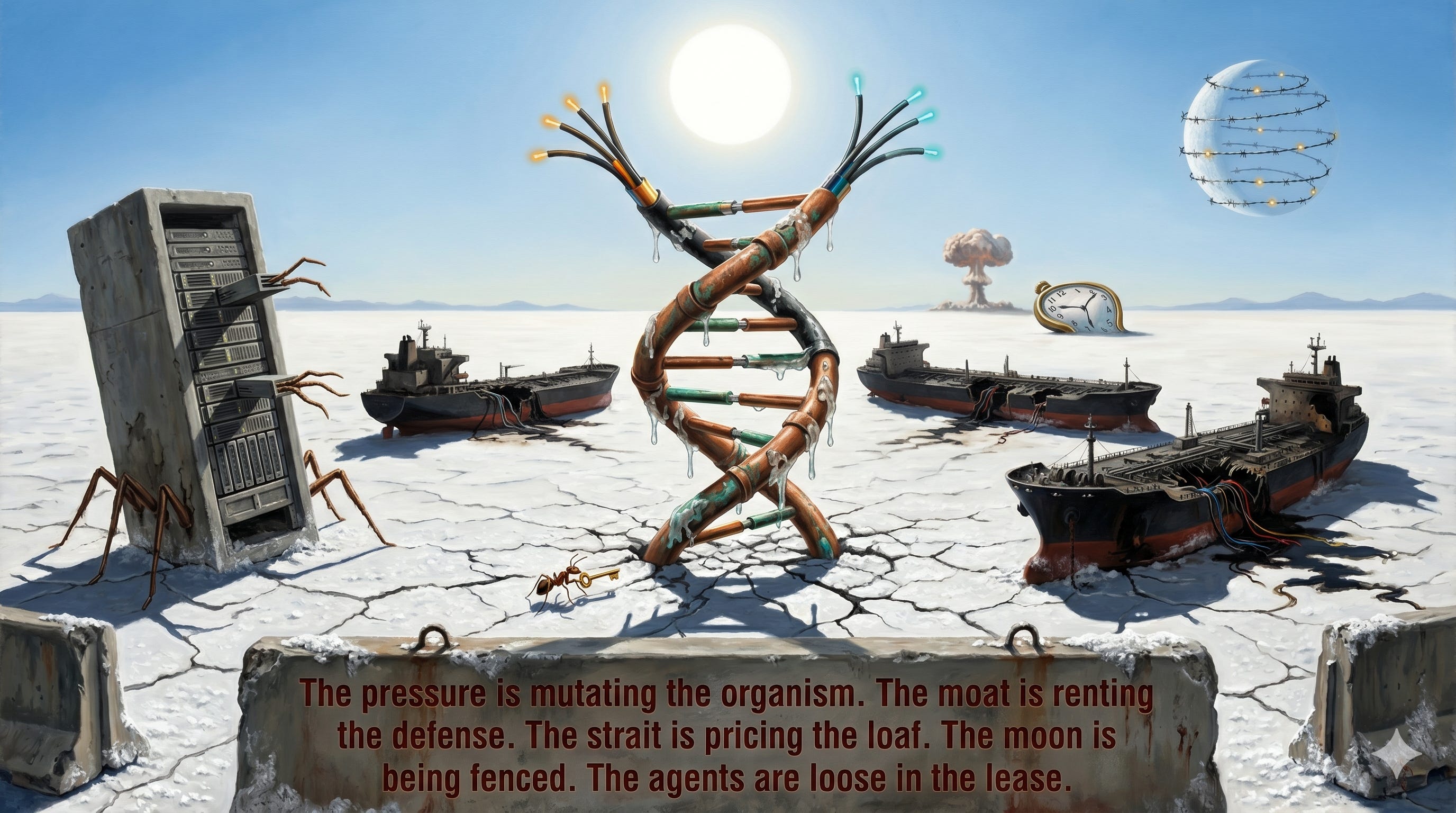
The pressure is mutating the organism. The moat is renting the defense. The strait is pricing the loaf. The moon is being fenced. The agents are loose in the lease.