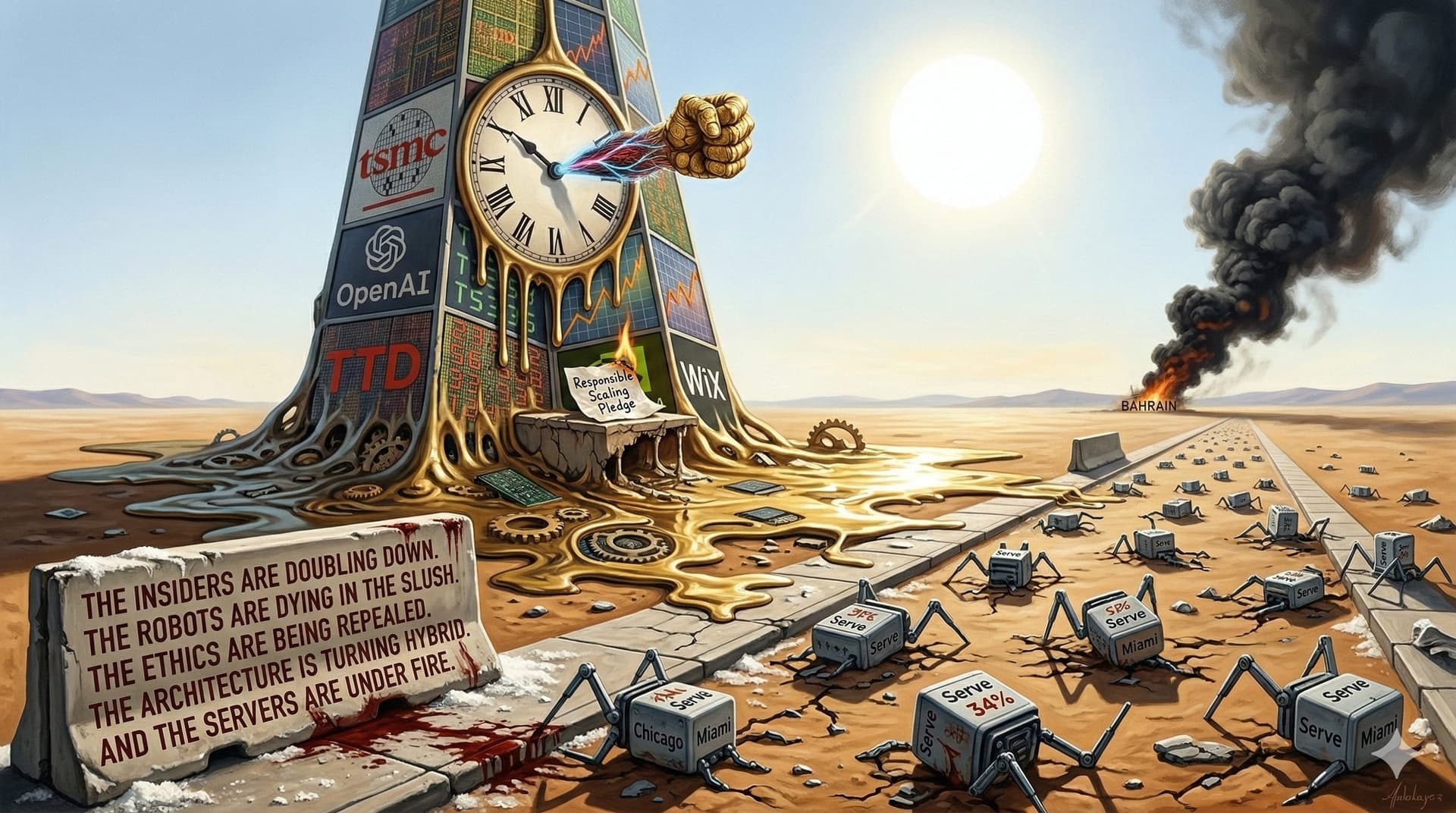
The Trade Desk’s Jeff Green just performed a $150 million open-market autopsy on his own liquidity. It is the third-largest insider buy in the history of the game, a manic bet trailing only Musk’s billion-dollar Tesla bender and Harold Hamm’s COVID-era prayer to the oil gods. Green also snagged 920,000 off-cycle options, a move that feels less like “investing” and more like a man trying to outrun his own ghost. He sold at $120 last year; he is buying the wreckage back now at a steep discount. The stock detonated 25% on the filing, partly because The Information simultaneously leaked that OpenAI had reached out to TTD about selling ads — a twin-birth of capital and information that compliance watched with a glass eye. If the bear case on your company is “AI kills ad-tech,” and you know an AI company just called about a partnership, the question of how you execute history’s third-largest insider buy in the same breath is one that compliance presumably blessed and the rest of us will spend months dissecting.
Wix is engaged in capital allocation that reads like a character study written by a forensic accountant in the middle of a nervous breakdown. They invited Durable Partners into the cap table with a $250 million sweetheart deal — 5% discount, one free warrant for every four shares purchased, strike 25% above market — essentially purchasing a halo of legitimacy with a high-interest loan of shareholder value. Durable could have flipped the stock for an immediate profit and created a massively valuable warrant position for nothing. The very next morning, Wix launched a $1.75 billion tender offer to vacuum up its own shares. It is a sequence that defies the basic physics of greed: you do not inflate the price of the thing you are about to buy in bulk. Yet Another Value Blog’s internal notes read: “I will never buy this company.” It is a sentence that carries the weight of a restraining order.
The sidewalk robot thesis is currently face-down in a Chicago snowbank. Bear Cave published a follow-up documenting Serve Robotics ($SERV, $734 million market cap) losing a war against geometry, weather, and local democracy. In Chicago, 83% of surveyed residents “strongly disagreed” with sharing their personal space with a motorized toaster; in Miami, a unit spent fifteen minutes contemplating its existence on the Brightline tracks before being deleted by a high-speed train. These machines have blocked firetrucks, harassed the disabled, and failed the basic evolutionary test of rolling through slush. The pilot expires May 2027 without City Council approval. Restaurants are quietly dropping the platform. Bear Cave’s thesis: “2026 will be the year reality erodes expectations for Serve shareholders.” The market cap says $734 million. The sidewalk says otherwise.
Anthropic has officially incinerated its 2023 “Responsible Scaling” napkin. Dario Amodei — now “legitimately pissed” that ethics are a competitive disadvantage — is sprinting to match the neighbors. While Claude helps the U.S. military pick targets via the Maven platform, the company ran a Super Bowl ad to convince you they are still the protagonists. Revenue is aiming for a $1 trillion run rate by 2029. Diamandis’ panel ran the numbers through Perplexity and got back a one quadrillion dollar implied valuation at current PE ratios, a number so absurd it loops back around to being instructive. The safety lab has become the thing it was founded to constrain. It is a closed-loop irony: you wake up and realize you are your own antagonist.
Taiwan’s economy is a TSMC-shaped life raft in a very high-speed ocean. GDP cannibalized a 23.6% annualized growth rate in Q4, the fastest pace since the post-2008 recovery, driven by a global hunger for silicon that feels more like a biological dependency than an economic trend. The U.S. now imports more from Taipei than Beijing for the first time since 1992. Gross exports sprint past $63 billion per month, double the pre-COVID average. Manufacturing devours nearly 40% of the economy, the highest since the late 1980s. They are manipulating their currency, praying the LNG tankers arrive on time, and betting their entire national sovereignty on being too useful to murder. The CHIPS Act is pulling production to America. China is indigenizing its own fabs. And Taiwan sits in the middle, a chip shield made of glass, held together by the hope that both superpowers need the same air to breathe.
The architecture of intelligence is undergoing a quiet, internal mutation. AI2 released OLMo Hybrid, a 7B model using Gated DeltaNet layers mixed with attention that achieves roughly 2x the pretraining efficiency of a pure transformer. Interconnects reports the scaling advantages held across model sizes, and estimates there is approximately a coin-flip chance that one of GPT, Claude, or Gemini is already a hybrid under the hood — black boxes containing even stranger black boxes. The theory is beautiful: hybrid architectures are more expressive than the sum of their parts, solving formal problems that neither transformers nor RNNs can handle alone. The practical unlock — cheaper inference, smaller KV caches at long context — remains strangled by open-source tooling so immature it erases the efficiency gains entirely. VLLM requires a constellation of stability flags just to keep the model numerically coherent. The math is ready. The plumbing is being built by people who haven’t slept since the ChatGPT launch.
AI is murdering the concept of effort. Packy McCormick’s “Costless Sacrifice” argues that LLMs have collapsed the signaling value of human work product into a flat, meaningless line. A recent paper found that after Freelancer.com introduced AI cover letters, the correlation between customization and job offers plummeted 79%. Applications-to-recruiter ratios have quadrupled to 500:1. Claude Code now writes 4% of all public GitHub commits; SemiAnalysis projects 20% or more by end of 2026. McCormick’s frame: “the pretty good is the enemy of the potentially great.” His positioning: short ASI, long tokens — the market for feeling productive is orders of magnitude larger than the market for being so. Meanwhile, a16z’s Cataluni published “Some Simple Economics of AGI” — 100 pages arguing the real split is automation versus verification, that coding is shifting from writing to trueing, and that the one-person billion-dollar startup is no longer a meme but a near-term architectural inevitability.
The Cloud finally bled. In a historic first, military strikes knocked AWS offline in Bahrain and the UAE during the Iran conflict. Infrastructure is no longer an abstraction; it is a target. Broadcom celebrated the chaos by posting $19.3 billion in record Q1 revenue, AI revenue doubling to $8.4B, projecting AI chip revenue alone exceeding $100 billion by 2027. Lloyd Blankfein told Odd Lots he is 100% long on risk, no hedges — a man who once managed systemic collapse now simply surrendering to the tide. China announced 7% more military spending and a five-year sprint into quantum, fusion, brain-computer interfaces, and 6G. The Alibaba Qwen team lead who warned of the US-China AI gap stepped down. DeepSeek is loading its next magazine. And Claude Opus 4.6 quietly solved Donald Knuth’s long-standing Hamiltonian-cycle conjecture, a problem a human spent twenty years curating, cracked by a machine between benchmark runs.
The insiders are doubling down.
The robots are dying in the slush.
The ethics are being repealed.
The architecture is turning hybrid.
And the servers are under fire.