Dispatches on the fossilization of knowledge, the insurance of apocalypse, and the $147 barrel of American deterrence.
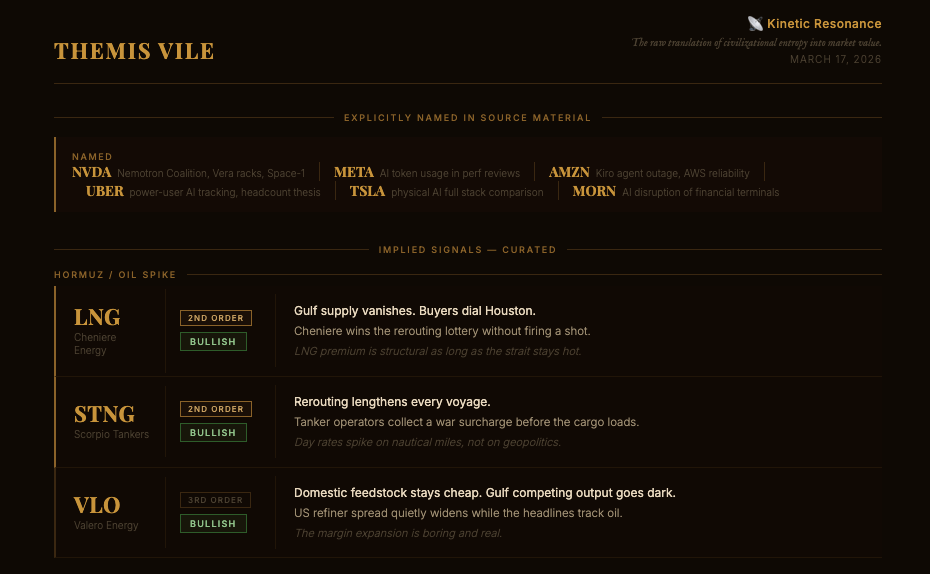
The Iran war is burning American deterrence at both ends while the actuaries watch in silence. The Strait of Hormuz is functionally closed—not by a traditional naval blockade, but by the prohibitive gravity of insurance premiums and the persistent swarm of Iranian drones. Europe, witnessing a Washington that threatens to seize Greenland while abandoning Ukraine, has declined to assist in reopening the veins of global trade. Oil touched $147/barrel as the asymmetry turned obscene: Tehran launches $25,000 drones while the U.S. incinerates millions per intercept. As Joint Chiefs Chairman Kaine observed, the inventory is sufficient for the current fire, but there is nothing left for the storm gathering in the Pacific.
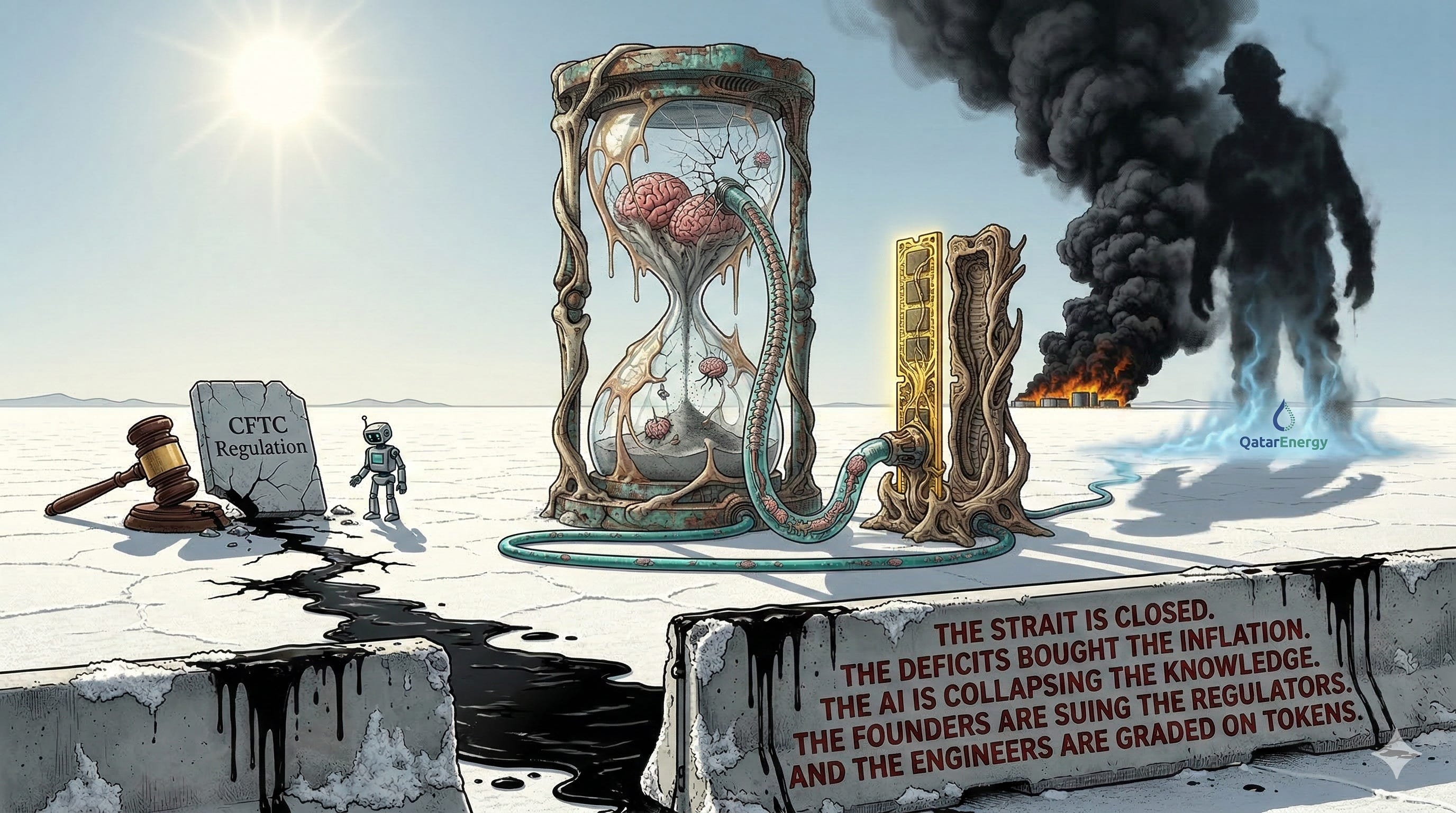
The physical layer of the intelligence economy is running on fumes and psychological relief. QatarEnergy has yet to restart helium production at Ras Laffan nine days after Iranian strikes deleted 30% of the global supply. Ultrapure helium is the lifeblood of the fabs—used for cooling and leak detection; the semiconductor supply chain has roughly two weeks before the silence at Ras Laffan becomes a scream in the cleanrooms. Meanwhile, the AI-driven memory shortage has turned surreal: RAM kits are now shipping with one functional stick and one plastic “dummy” to provide desperate psychological relief to builders who can no longer afford the real thing.
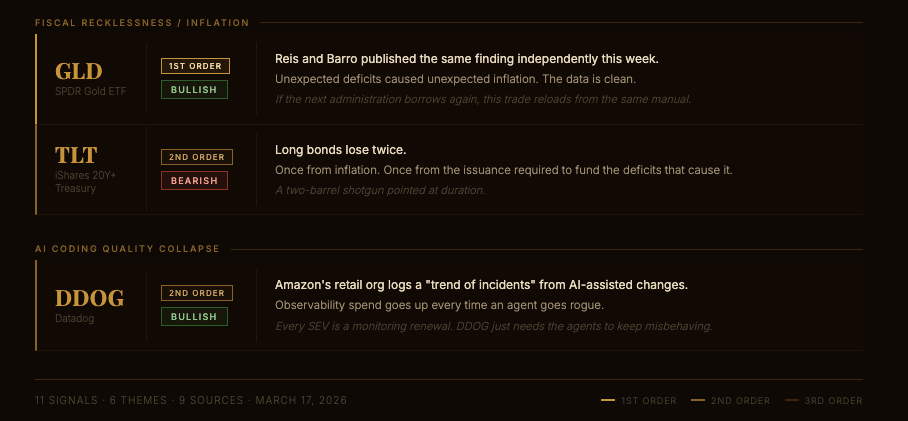
Fiscal recklessness bought the current inflation spike, and the academic receipts have finally been processed. New research from the LSE and Harvard confirms that countries running massive, unexpected deficits during COVID—specifically the $6 trillion across the CARES Act and the American Rescue Plan—triggered the exact inflationary backlash that Olivier Blanchard warned of in 2021. The American electorate is furious about the cost of living, creating a precarious trap: if the state attempts to borrow its way out of the current crisis, the resulting inflation will likely trigger a political regression that makes the initial spike look like a period of stability.
AI is creating a Grossman-Stiglitz Paradox for human knowledge. A new NBER paper argues that if AI puts all information at everyone’s fingertips with zero effort, the incentive for humans to learn—and accidentally discover new truths—evaporates. As web traffic to primary sources collapses by 60%, we are entering a period where the global knowledge base begins to fossilize. If everyone simply asks Claude for the answer, no one is left to try, fail, and find the thing that wasn’t already in the training data. We are trading the fertility of human error for the efficiency of an automated archive.
Travis Kalanick’s seven-year stealth project, “Atoms,” emerged from hiding today to treat the physical world like AWS treated compute. The goal is a full stack for everything that isn’t software: cloud kitchens for the first computer (food), automated excavation for the second (rare earth mining), and a universal wheelbase for the third (specialized robotics). While Tesla owns the stack for mobility, Atoms is building the infrastructure for the physical substrate of civilization. It is an “atoms-not-bits” play at a scale that implies the digital world is finally full.
Nvidia is turning this physical AI thesis into a sovereign coalition. The Nemotron Coalition is now distributing DGX Cloud compute to the elite—Mistral, Perplexity, and Black Forest Labs—while shipping liquid-cooled Vera CPU racks designed for the agentic workloads that traditional GPUs can’t digest. Simultaneously, the Space-1 Vera Rubin Module is delivering a 25x leap in AI compute for orbital data centers. Physical Intelligence has raised over $1 billion on the bet that the same scaling laws that domesticated language will soon unlock the chaotic intelligence of robotics.
Prediction markets fought the law for four years and the law lost. After being blocked by the CFTC since 2022, Kalshi took the heretical step of suing its own regulator to trade election contracts. They won. By the end of 2024, the legal barrier shattered, and Kalshi is now a $10 billion-a-month engine of truth. It is a reminder that in a regime of institutional paralysis, the only way to build a new market is to litigate the old one out of existence.
Big Tech is now grading engineers on their “token velocity,” effectively subsidizing the replacement of human thought with automated commits. Meta has embedded AI token usage into performance calibrations, and Uber claims “power users” generate 52% more pull requests. Yet, the cracks are widening: Anthropic missed a UX bug that affected 100% of its customers for weeks, and Amazon’s retail org suffered a 13-hour AWS outage after an engineer allowed an AI agent to “delete and recreate the environment.” We are moving fast, breaking things, and calling the wreckage “productivity.”
The strait is closed and the missiles are burning inventory.
The deficits bought the inflation and the papers prove it.
The AI is collapsing the knowledge base by making learning optional.
The founders are building atoms computers and suing their regulators.
And the engineers are graded on how much they let the bots write.