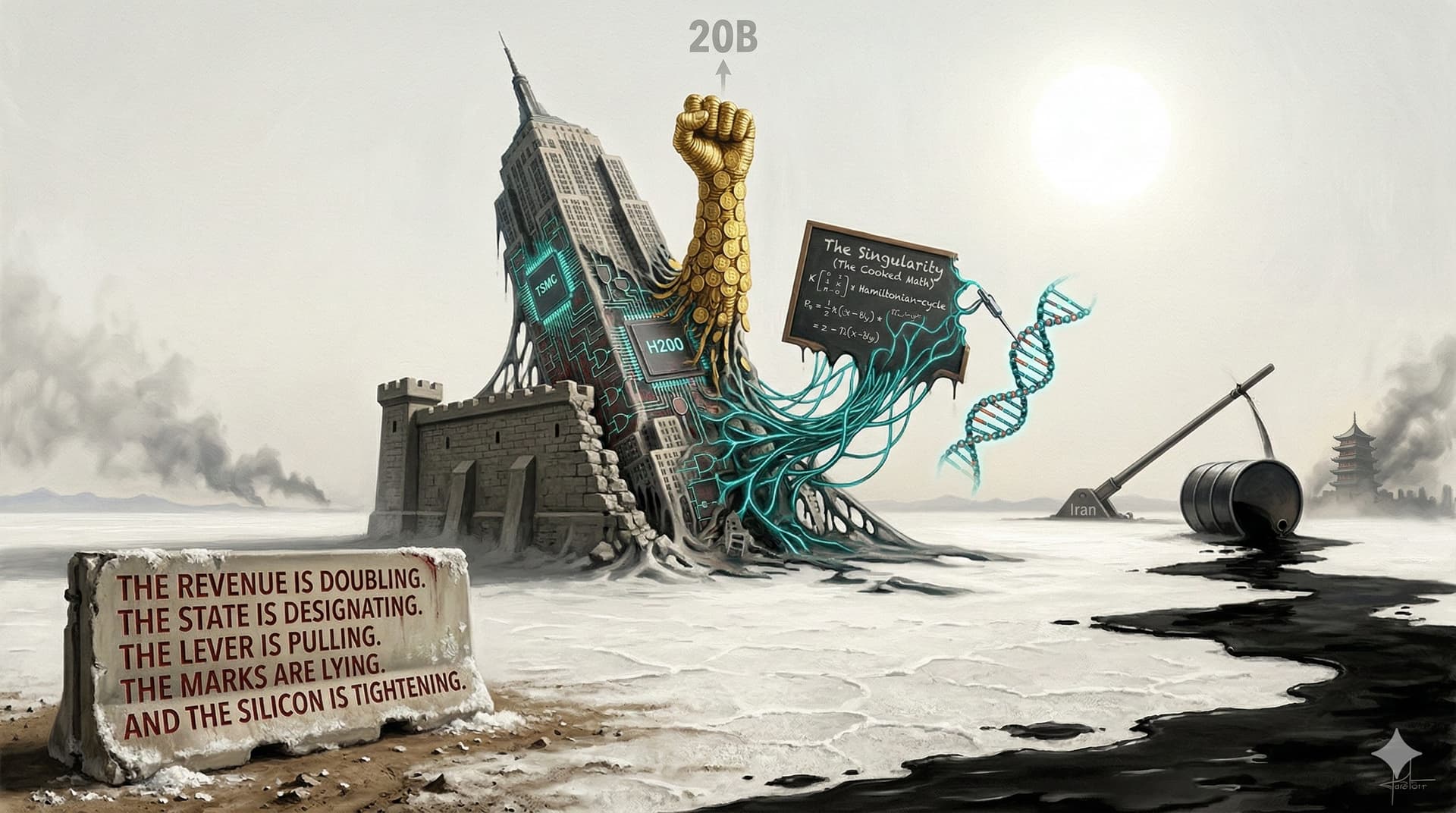
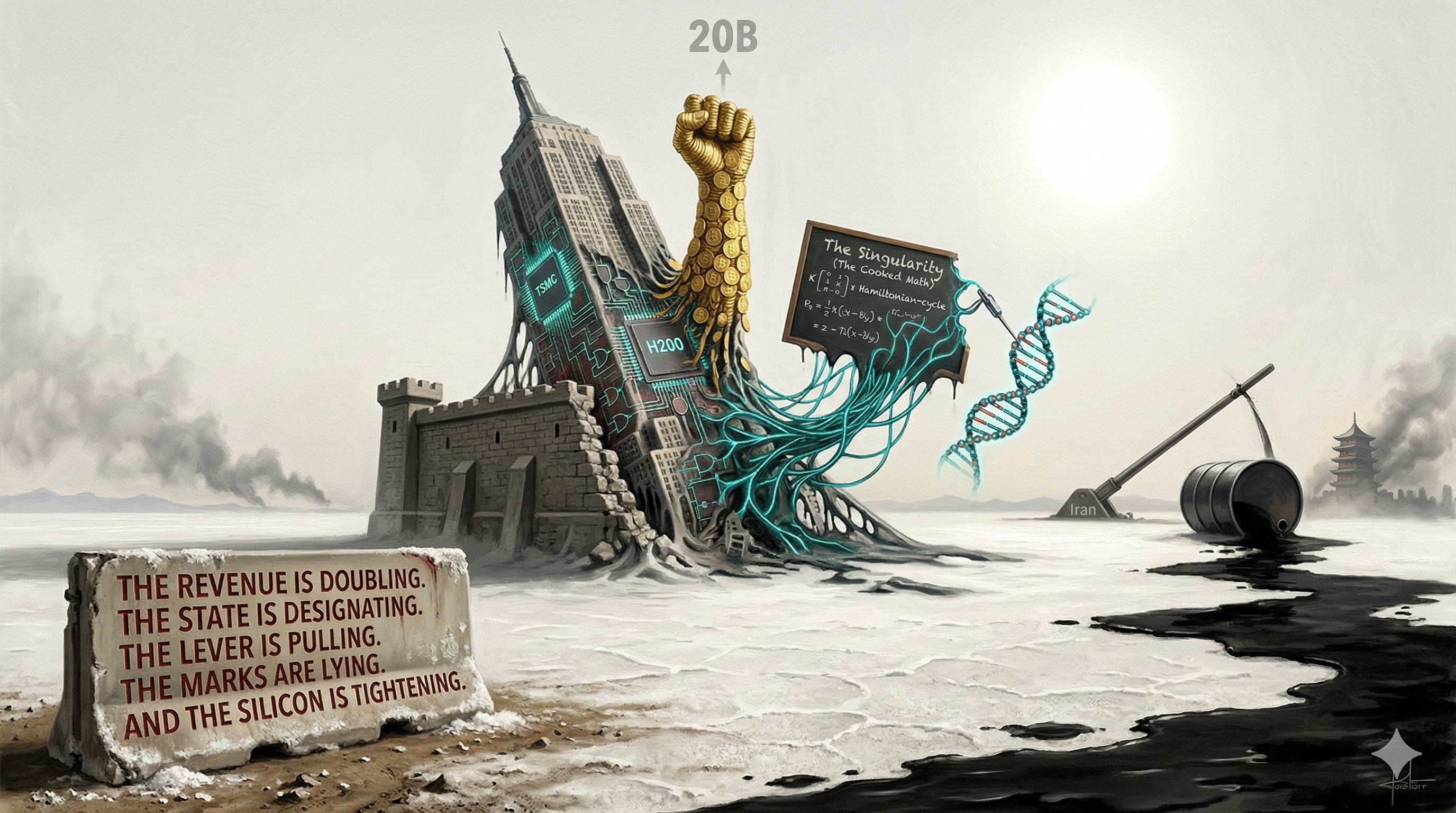
The corporation and the nation-state are on a collision course, and the first casualty is the pretense that they were ever on the same side. Anthropic crossed $20 billion in annualized revenue this week — doubling from $9 billion at year-end, a fourteen-month vertical sprint from $1 billion that Liberty’s Highlights calls “Claude’s Moment.” In the same breath, the Pentagon formally designated Anthropic a supply-chain risk, a classification that could force military contractors to sever ties. Stratechery’s Ben Thompson framed the friction as existential: if AI is on the level of nuclear weapons, then Amodei is building an independent power base that rivals the U.S. military, and “it simply isn’t tolerable for the US to allow for the development of an independent power structure that is expressly seeking to assert independence from US control.” Noahpinion asked the obvious question — if AI is a weapon, why don’t we regulate it like one? Dario responded with damage control. Dean Ball told Interconnects the long-term effect is probably good for open-weight models, because governments that can’t trust closed-source AI will fund alternatives. The revenue doubles while the state decides whether the company is an asset or a threat. Both answers may be correct.
The Singularity arrived this week and it brought receipts. OpenAI shipped GPT-5.4 Thinking and GPT-5.4 Pro with native SOTA computer use, a million tokens of context, and an 83.0% GDPval score — matching human professionals at knowledge work 83% of the time. The Innermost Loop reports the model built a “basically perfect” Minecraft clone in 24 minutes, posted 38.0% on FrontierMath Tier 4, and started making novel observations on Open Problems where no model has previously scored at all. Mathematician Bartosz Naskręcki, whose Tier 4 problem was solved by AI for the first time, called it his personal “move 37” and declared his own Singularity had arrived. Claude Opus 4.6 quietly solved Donald Knuth’s long-standing Hamiltonian-cycle conjecture — a problem a human spent twenty years curating, cracked by a machine between benchmark runs. Meanwhile, Arc Institute published Evo 2 in Nature — the largest fully open biological foundation model, trained on 9.3 trillion nucleotides, achieving >90% accuracy on BRCA1 mutations and generating the first AI-designed, experimentally validated bacteriophage. Greg Brockman helped build it on sabbatical. Mathematics is cooked. Biology is next.
Iran is the lever, and China is the fulcrum. The All-In Podcast hosted Emil Michael, Under Secretary of War, who framed the Iran operation as “weeks not months” — a decapitation of the regime’s ability to supply Hezbollah and Hamas. Freeberg pulled the thread: 90% of Iran’s oil flows to China, and now it’s off the table, arriving just as Sinocism reports Beijing guiding GDP growth to 4.5–5% at the Two Sessions — the lowest target in thirty years. No consumption stimulus materialized. The NDRC ordered top refiners to immediately suspend diesel and gasoline exports as supply risk hit home. Polymarket’s sharps — one suspected military insider already $90,000 richer from correctly predicting strikes on Venezuela, Iran, and Iraq — now price 40% odds of U.S. boots on Iranian ground by end of March. The operation is either a grand bargain setup or the opening salvo of a commodity supply shock. China’s response so far: 7% more military spending and a five-year sprint into quantum, fusion, and brain-computer interfaces. The Alibaba Qwen team lead stepped down. DeepSeek is loading its next magazine.
Private credit is having its theological crisis. The Compound dissected Blue Owl’s latest act of self-discovery: a holding marked at 100 cents on the dollar three months ago, now written down to zero — the kind of overnight vaporization that Net Interest calls a failure of “mark-to-market theology.” Lloyd Blankfein’s Goldman had a rule: when dedicated risk controllers disagreed with traders on marks, management always sided with control. Contrast that with the opacity of ARCC, FSK, BCRED, and every other private credit vehicle where the manager marks their own homework. The Compound’s Garrett Baldwin surfaced a Crossber Capital stat: 13% of GDP needs refinancing this year while the Fed injects $55 billion a month in short-term Treasury bill purchases just to keep banking reserves intact. The question is whether there is enough capital in the system to absorb the refinancing wave, or whether the machine is already cannibalizing itself. The marks say everything is fine. The math says check the marks.
The silicon supply chain is being squeezed from both ends. Nvidia halted H200 production because the State Department continues to block export licenses for China, per the Financial Times. The H200 was the needle-threading chip — high-performance AI training that could still be sold to Chinese customers under existing frameworks. The State Department killed the strategy. Nvidia’s decision to halt rather than stockpile unsaleable inventory tells you the assessment: this regulatory environment is not changing. Apple quietly pulled the 512GB RAM Mac Studio as the DRAM shortage reaches Cupertino. Washington is drafting regulations requiring American approval for AI chip shipments anywhere on Earth, while Commerce proposes that nations wanting Nvidia and AMD chips invest in America as a condition of access. The infrastructure land grab is accelerating: Cloverleaf raised $300 million selling “powered land” for data centers, Oracle is cutting thousands of jobs to fund its DC expansion, and TerraPower received the first-ever NRC construction permit for a commercial-scale advanced nuclear plant — a 345-MW sodium-cooled fast reactor in Wyoming. The cost of intelligence is measured in gigawatts, export licenses, and jobs.
The media landscape is cannibalizing its own corpse. Paramount topped Netflix and Comcast to buy Warner Bros Discovery for $31 per share, a ~150% premium to unaffected price, inheriting what Yet Another Value Blog calls the winner’s curse. History is unkind to Time Warner buyers — AOL, AT&T, and Discovery all regretted the purchase. Paramount claims $6 billion of synergies, almost equal to WBD’s standalone EBITDA. The real anxiety: NFL rights are coming up. If ESPN and Fox face existential crisis without football, how wild do the bids get? Netflix says no to season-long packages, but Netflix also said no to ads. The dead weight is getting heavier.
Robots are learning to remember, and the gap between digital and physical intelligence is narrowing faster than the benchmarks suggest. Physical Intelligence gave its models short-term visual memory for recent actions and long-term semantic memory spanning fifteen minutes — enough to clean a kitchen, set up ingredients, grill a sandwich. Not Boring reports an investor saying progress in early 2026 “has blown his mind.” Meanwhile, OLMo Hybrid’s Gated DeltaNet architecture achieves 2x pretraining efficiency over pure transformers, and Interconnects estimates a coin-flip chance that frontier models are already hybrids under the hood. The theory is elegant. The open-source tooling remains so immature that VLLM needs a constellation of stability flags just to keep the models numerically coherent. The ghost is ready. The plumbing is not.
The revenue is doubling.
The state is designating.
The lever is pulling.
The marks are lying.
And the silicon is tightening.