Jordi Visser named it first, though he wasn’t the only one who felt it: strategists, analysts, and allocators are still fighting 2025. They have their positions charted on maps of a battlefield that no longer exists, and they are executing those positions with the conviction of people who were right once, recently, and cannot yet metabolize the possibility that the terrain has shifted beneath them. This is the TACO PTSD thesis — the acronym is his, the condition is universal — and it stalks the week like a slow bleed. Meanwhile, from the semiconductor fabs to the defense floors to the crypto desks, the actual war is being fought on new ground: inference over training, open-source over moat, rearmament over deterrence, and a crypto rally so clean that the only two assets trading above their 50-day moving averages are Bitcoin and Ethereum.
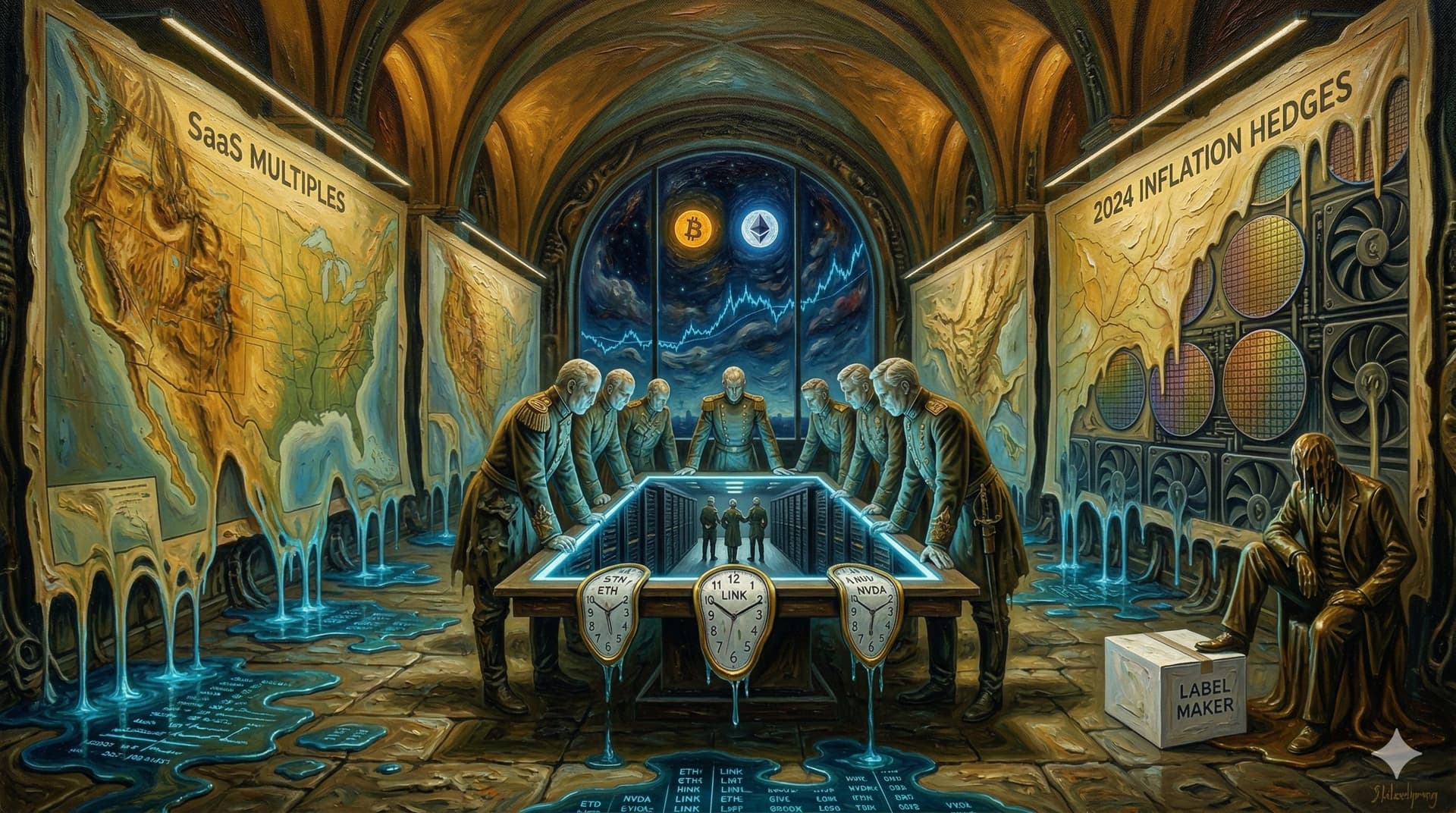
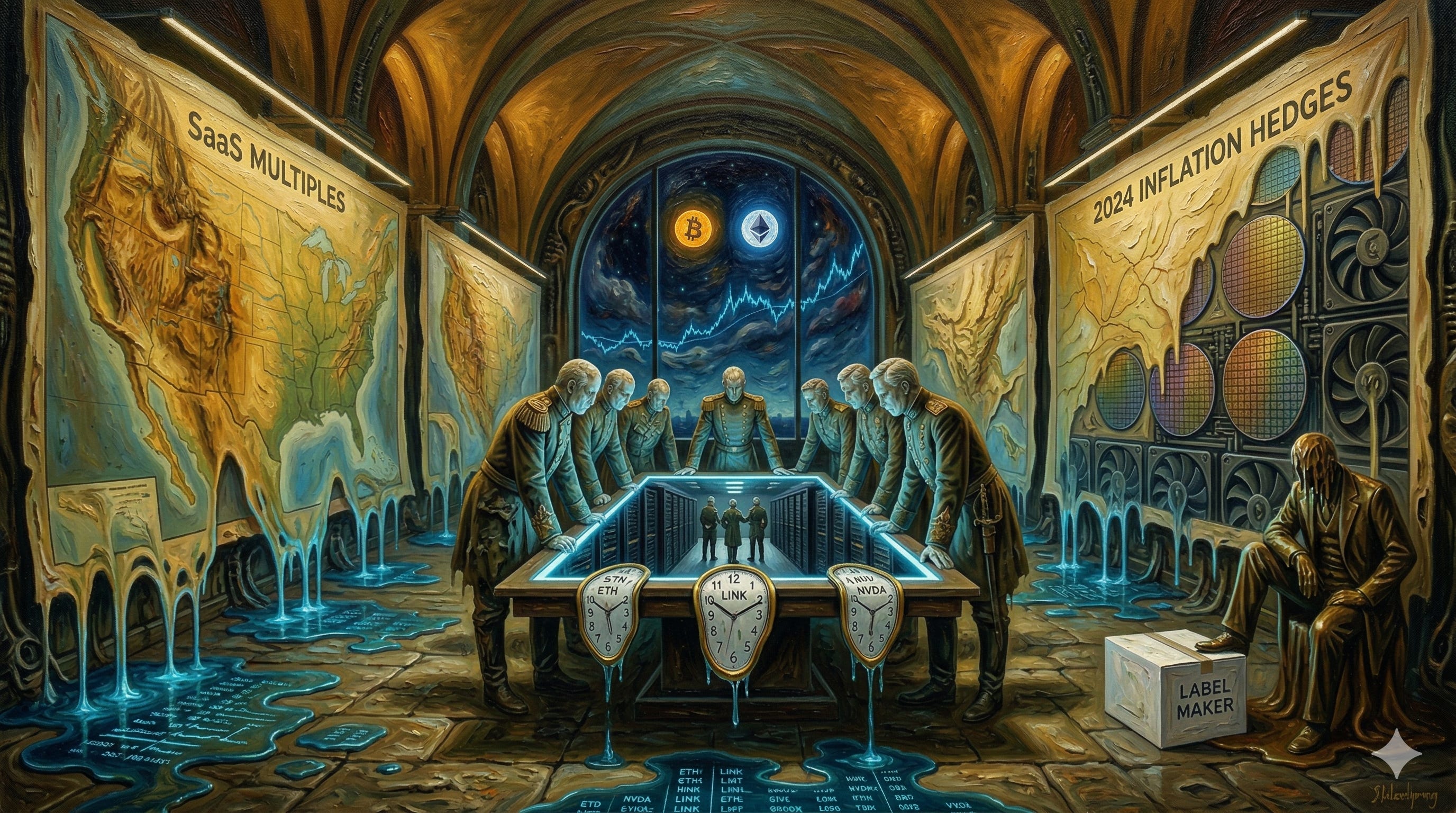
The generals are refighting the last war. They are huddled in war rooms where the maps on the wall are made of yellowing parchment—old SaaS multiples and 2024-era inflation hedges—rotting in a space where the air conditioning has already failed. They are executing maneuvers with the absolute conviction of people who were right once, recently, and cannot yet metabolize the fact that the terrain has shifted beneath their boots. The last war's maps aren't just wrong; they are a form of cognitive lock-in that is currently being repriced in real-time.
The signal this week didn’t arrive as a set of talking points; it arrived as a slow, localized bleed. While the "smart money" is busy pattern-matching to last year's dips, the actual war has already migrated to new coordinates: Inference over training, Open-source over moats, and a Rearmament Trade that has moved from the think-tank "rocks" to the institutional spreadsheet.
The Big Picture
The Generals Are Refighting Stalingrad
The dominant macro pathology this week is not a bad trade — it’s a bad frame. The instinct to pattern-match to 2025’s playbook, to treat every dip as a buying opportunity structured like the last one, to hedge against the inflation spike that already happened, to position for the rate cycle that already turned — this is the cognitive trap that Visser identified and that the broader data confirms. Private credit is being used to launder volatility off balance sheets. Inflation-linked real assets are being accumulated against a shock that may have already been priced. The last-war maps incorrect and they are load-bearing - look out below. Institutions have built risk frameworks on top of them. When those frameworks crack, they don’t crack quietly.
The tell is in the sentiment data — and this week it reads like a confession. GOOGL, discussed by 14 independent channels, is only 27% bullish. AMZN at 11 channels comes in at 31%. MSFT at 10 channels sits at 35%. META, 9 channels, 26%. These are not stocks in trouble. These are stocks whose stories are being rewritten in real time, and the market is pausing mid-sentence. The analysts who built their frameworks around the 2025 AI consensus are now looking at the same names with the same conviction and arriving at uncertainty. That’s not pessimism. That’s the sound of a map being redrawn.
The Inference Pivot and the New Hardware Lottery
NVDA at 64% bullish across 16 channels is the most interesting number on the board — not because it’s low, but because a year ago it would have been 95%. The training-era consensus is dissolving. The question is no longer who builds the biggest model; it’s who builds the fastest, cheapest inference layer. And that question reshuffles the deck. Specialized accelerators for token-diffusion workloads, edge AI chipsets for latent world models, heterogeneous compute stacks pairing Vera CPUs with Rubin GPUs with Groq LPUs — the hardware lottery is being redrawn, and the winning ticket looks different than it did eighteen months ago.
This is where the open-source signal cuts deepest. Jensen’s OpenClaw thesis, circulating across both Substack and YouTube this week, is not just a product announcement — it’s a declaration that the default development layer is going open, which means the moat migrates from the model to the infrastructure around the model: hosting, tooling, enterprise support, the unglamorous plumbing that keeps the lights on at 3am. The firms that own that plumbing — and can price it — are the ones the smart money is quietly accumulating while everyone else argues about parameter counts.
The Rearmament Trade Has a Pulse, and It’s European
Perun’s deep-dive on global arms export trends landed this week like a suppressed gunshot — quiet to the casual observer, loud to anyone paying attention. The data is unambiguous: European defense OEMs are in an expansion cycle driven not by aspiration but by order backlogs. The allied defense build-up is not a theme anymore; it’s a contract. Counter-UAS systems, anti-access platforms, integrated air defense procurement in the Gulf — these are procurement cycles with delivery schedules. The war on the rocks is also, increasingly, the war in the spreadsheet.
Signal Convergence
The Infrastructure Layer Nobody Is Arguing About
The highest-signal convergence this week is also the quietest. Across enterprise AI, edge AI, open-source AI, and specialized hardware — four distinct theme clusters sourced from both Substack and YouTube — the independent voices are not arguing about whether the infrastructure buildout continues. They are arguing about which layer captures the value. The technical purists and the macro-vultures arrived at the same coordinate: the training era is plateauing, the inference era is accelerating, and the winners are the picks-and-shovels plays that don’t need to pick a model winner. This is the ambient intelligence trap inverted — instead of everyone buying the obvious AI names, the convergence is pointing beneath them, to the substrate.
The Consensus Fracture in Plain Numbers
The board this week is the TACO PTSD thesis expressed as a table. Every major AI incumbent — NVDA, GOOGL, AMZN, MSFT, META — is running majority neutral or bearish in explicit source sentiment. GOOGL, the most-discussed name at 14 channels, is 27% bullish with 29 neutral mentions. AMZN at 11 channels is 31% bullish. META at 9 channels is 26% bullish. This is not a crash thesis. It’s something more interesting: the sources that have the most to say about these names are the ones most uncertain about what to do with them. The last-war playbook had clear answers. The current terrain doesn’t.
Against that backdrop, two signals stand out by their cleanliness. BTC at 69% bullish across 4 channels — no noise, no debate, directional. UBER at 69% bullish across 7 channels — the AI-native infrastructure thesis landing on a consumer logistics company that nobody expected to be the week’s clearest large-cap conviction trade.
The Revenue Durability Fracture
OnlyCFO’s piece on ARR durability failing in the age of AI is the week’s most underappreciated signal. The argument: multi-year enterprise SaaS contracts — the architecture that made high-NRR SaaS the institutional darling of the last decade — are being quietly renegotiated or not renewed, because AI is collapsing the cost of the function the software was performing. The ARR waterfall is draining. This is why AMZN and MSFT’s neutral counts are so high — the analysts who built DCFs on SaaS multiples are staring at the waterfall and doing the math again. Whether the replacement architecture is priced correctly is the question nobody has cleanly answered yet.
If this is hitting different, subscribe — next week’s convergence drops Tuesday ->
The Board
Summary: The board this week is a map of productive uncertainty. The AI mega-cap layer — NVDA, GOOGL, AMZN, MSFT, META — is the most-discussed cohort in the pipeline and the most divided. Every one of them runs majority neutral or bearish by explicit source sentiment. That’s not a crash signal; it’s the market mid-sentence, rewriting a thesis it no longer fully trusts. Against that backdrop, two names stand as the week’s actual conviction trades: UBER at 69% bullish across 7 channels — the AI-infrastructure-of-movement thesis landing with unexpected clarity — and BTC at 69% bullish across 4 channels, trading above its 50-day while everything else thrashes. The meta-story: the last war’s maps are wrong, the new maps are only half-drawn, and the only things moving cleanly are the ones nobody was arguing about.
NVDA · Stock · 16 sources · Substack, YouTube
Inference-Era GPU Dominance | Open-Source AI Platform Strategy | Edge AI Compute | Autonomous Vehicle Silicon
“Nvidia’s strategy seems to be the Android of self-driving — a modular horizontal platform for the whole ecosystem.” — Interconnects
64% bullish — the floor is higher than the number suggests; 8 bearish mentions represent the first real dissent on NVDA in two years
GOOGL · Stock · 14 sources · Substack, YouTube
AI Agent Development Platforms | Search Disruption Risk | World Model Research | Ad Revenue Displacement
“The team working on the Agent inside Google DeepMind’s World Model, Genie, is named Inception.” — Interconnects
27% bullish — the most discussed name on the board and the most divided; 29 neutral mentions means smart money isn’t bearish, it’s waiting
AMZN · Stock · 11 sources · Substack, YouTube
AI Compute Infrastructure | AWS Reliability Questions | Corporate Robotics | Developer Tooling
“Amazon Web Services experienced a 13-hour interruption to one system used by its customers in mid-December.” — The Compound
31% bullish — the AWS reliability question is getting louder; 15 neutral mentions suggest thesis-in-transition, not conviction
MSFT · Stock · 10 sources · Substack, YouTube
Enterprise AI Copilot Monetization | Open-Source Licensing Pressure | Developer Infrastructure | SaaS ARR Durability
“This is what Microsoft was in the early days, what Google was, but times 100, times a thousand.” — Jeremy Lefebvre Financial Education
35% bullish — 4 bearish mentions, 9 neutral; the copilot monetization thesis is fighting the SaaS ARR erosion thesis inside the same stock
UBER · Stock · 7 sources · Substack, YouTube
AI-Native Logistics Infrastructure | Autonomous Vehicle Platform Integration | Power-User Developer Adoption
“Uber is a good example — Big Tech CEOs are starting to see AI power user devs as superior to their coworkers.” — Not Boring by Packy McCormick
69% bullish — the week’s cleanest large-cap signal; 7 independent sources, minimal bearish noise, coherent thesis
BTC · Crypto · 4 sources · Substack, YouTube
Digital Store of Value | Crypto-as-Collateral Infrastructure | Macro Hedge
“A lot of our LPs on the BTC whale side are institutions that may have a core Bitcoin position.” — RaoulPal
69% bullish, 0 bearish — trading above its 50-day while equities thrash; the clearest directional read on the board
AAPL · Stock · 4 sources · Substack, YouTube
On-Device AI Revenue | India Supply Chain Buildout | Consumer Hardware Cycle
“Apple is on track to surpass $1 billion in AI revenue this year.” — peterdiamandis
56% bullish — modest conviction; the AI revenue thesis is forming but not yet consensus
Bear Watch
Bear COF · 2 sources · 100% bearish
“Capital One Financial is down 26% year to date.” — Jeremy Lefebvre Financial Education
Two independent voices arriving at the same bearish coordinate without coordination. The rate-sensitive consumer credit thesis has teeth: if the last-war playbook assumed rates staying elevated and consumer credit holding, Capital One is exactly the kind of name that gets caught in the repricing. Watch for charge-off acceleration in the next earnings cycle.
Momentum Watch
Heating up:
UBER — 7 channels, new to the board with coherent thesis. The AI-native infrastructure angle on a consumer logistics company is unexpected, which is exactly why it’s worth watching.
AMD +3 channels week-over-week — the inference-era hardware reshuffling thesis is pulling AMD back into conversation as an NVDA alternative.
TSLA — 7 channels, 40% bullish. The self-driving delay thesis and the autonomous platform thesis are in direct conflict inside the same ticker.
ASML — 3 channels, 50% bullish. Appearing in semiconductor supply chain conversations exactly when TSMC constraint discussions peak. Second-order signal.
SOFI — 2 channels, 75% bullish. The fintech recovery thesis is quiet but directional.
Cooling off / worth noting:
META at 26% bullish across 9 channels — the board’s most bearish-leaning name. Token usage in performance reviews and world-model robotics are pulling the thesis in opposite directions.
INTC at 13% bullish across 4 channels — the reshoring narrative isn’t translating to conviction. The policy thesis and the execution reality are diverging.
IBM and GS both at 0% bullish — entirely neutral mentions, context-only. Neither is generating investment theses.
What We’re Ingesting
OnlyCFO — “Revenue Durability is Failing in the Age of AI” · The most important piece of the week that nobody is treating as important. The ARR waterfall thesis is not a prediction — it’s an observation about contracts already in renegotiation. If you have SaaS multiples in your portfolio and you haven’t read this, you are fighting the last war.
Jordi Visser — “2025 TACO PTSD” · The week’s thesis in a title. Required viewing for anyone who found themselves saying “this feels like last February” this week.
Perun — “Global Arms Exports: Trends, Winners & Losers of the Race to Rearm in 2025” · The defense data layer that makes the LMT thesis feel less like a thesis and more like a procurement schedule. Actual order-of-battle analysis applied to equity implications. If you’re in the defense trade and you’re not watching this channel, you’re missing the primary source.
Interconnects — “Lossy Self-Improvement” · The AI safety piece that doubles as an inference architecture argument. Dense and worth the second read.
War on the Rocks — “The Battlefield is the Next Betting Market” · Commercial OSINT data providers as an investment thesis. High-resolution satellite imaging as the intelligence layer for hedge funds as much as governments. This piece names the dynamic without naming the tickers — which is exactly the gap Themis exists to close.
Doomberg — “Island Hopping” · The geopolitical energy hedge piece of the week. Domestic oil and gas reshoring for island nations mapped onto strategic fuel reserve infrastructure and the Hormuz corridor disruption thesis.
Noahpinion — “China is quietly looking weaker” · The China industrial-policy fatigue argument, empirically stubborn. Hold alongside the War on the Rocks China piece for the full stereo picture.
Yet Another Value Blog — Adam May on $NKTR $ABVX · Beta-adjusted asymmetric biotech plays by someone who has actually read the clinical data. Specialty read, high signal-to-noise for the biotech-curious.
The Closing Note
The maps are still on the wall. That’s the week in one image — not the battles being fought, but the battles being prepared for, the ones whose terrain was memorized in 2025 and whose coordinates are being called in with absolute conviction to positions that no longer exist. The inference pivot is not a new map. It’s the discovery that the old map was drawn by someone who had never been to the territory. The crypto clarity is not a new map either — it’s the market’s way of saying that the only things trading above their 50-day are the ones that stopped pretending the old map was accurate. The rearmament trade is not a new map; it’s a very old map that everyone forgot was still in the drawer. And the ARR waterfall draining out of enterprise SaaS — that’s the moment you realize the map you built your entire risk framework on was drawn on water.
I wrote too many words about strategists fighting the last war. I then spent forty-five minutes this morning reconfiguring a position I opened in November based on a macro thesis that I know, with the specific, fluorescent certainty of someone who has read the Visser piece twice, is no longer operative. The position is not large. That’s not the point. The point is that I moved it slightly, told myself I was “managing” it, and then made a cup of coffee and came back to write about cognitive lock-in. The maps are on my wall too. One of them has a sticky note on it that says “revisit.” The sticky note has been there since January.
The generals have beautiful maps. The market has already taken the hill.
Note [v.3.1] — On the Load-Bearing Capacity of Unopened Productivity
There is a specific, quiet desperation in the purchase of a Brother P-touch PTD210 [v.3.1.1]—an organizational fetish-object acquired three weeks ago with the explicit, if developmentally arrested, intent of imposing a taxonomical order upon the “Cable-Nest” [v.3.1.2] currently gestating behind my desk. The device remains in its original high-gloss corrugated packaging, which is to say it has been successfully integrated into the room’s architecture not as a tool, but as a structural footrest. There is something cosmically, almost statistically, correct about this: the very apparatus purchased to mitigate the chaos has been co-opted as a load-bearing member of the chaos it was meant to solve. This is the Enterprise SaaS thesis in its terminal state. You buy the “solution” to fix the ARR waterfall, only to realize the solution’s box is the only thing keeping your feet off the damp, oily floor of the basement. Somewhere in a Northern Virginia data center, a redundant server rack is being used as a literal doorstop by an AI agent that has already siphoned the signal and moved on. The tools aren’t “optimizing” the problem; they are the new, unlabelled walls of the problem itself.
Note [v.3.1.1]: Brother Industries (6762.T). Their stock is not on the board. In a week where the TechnoCore is pricing orbital compute and token-diffusion workloads, a company that specializes in thermal-transfer tape and “Laminated Labels” is a relic of a pre-metabolic reality where things actually stayed where you put them.
Note [v.3.1.2]: I have started referring to this specific geometry of dust-caked HDMI and Type-C peripherals as “The Situation,” a term I use with the defensive, shell-shocked tenderness of a man who has realized that the “Software Reckoning” starts at the power strip.Note [v.3.2] — On the Acronym as a Cognitive Gasket
The TACO PTSD acronym—Trump Always Chickens Out—is the specific, linguistic scar tissue of the last war. It serves as a diagnostic gasket, a way for the the analysts to rationalize their current paralysis by pattern-matching to the 2025 tariff-fiasco. They learned that the bark is the bite, and now they are huddling in war rooms where the maps are melting because they’ve decided the smoke is just a negotiation tactic. To name the monster is to pretend you have caged it; to call it “TACO” is to bet your entire risk framework on the idea that the floor isn’t actually falling out from under you.