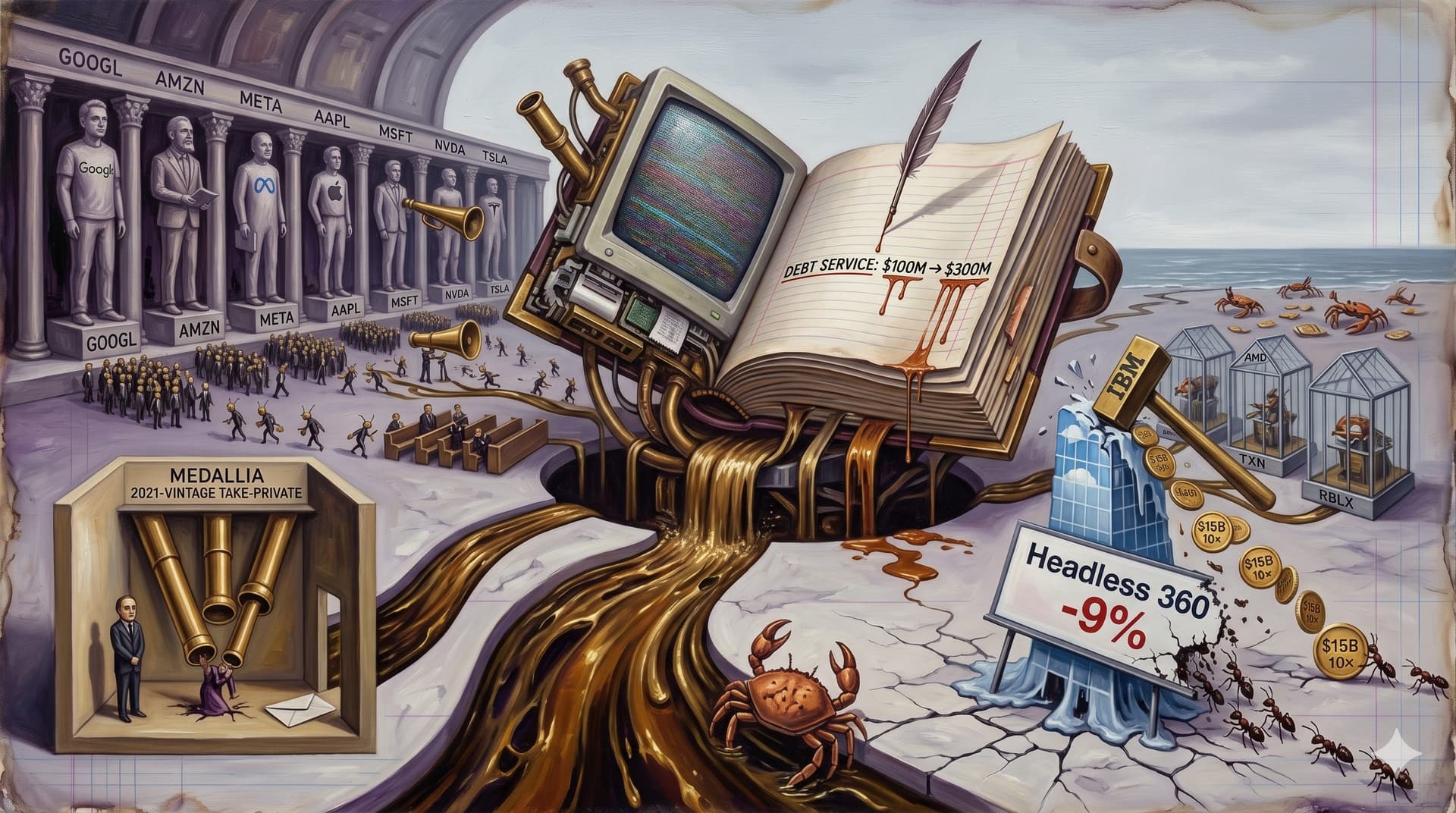
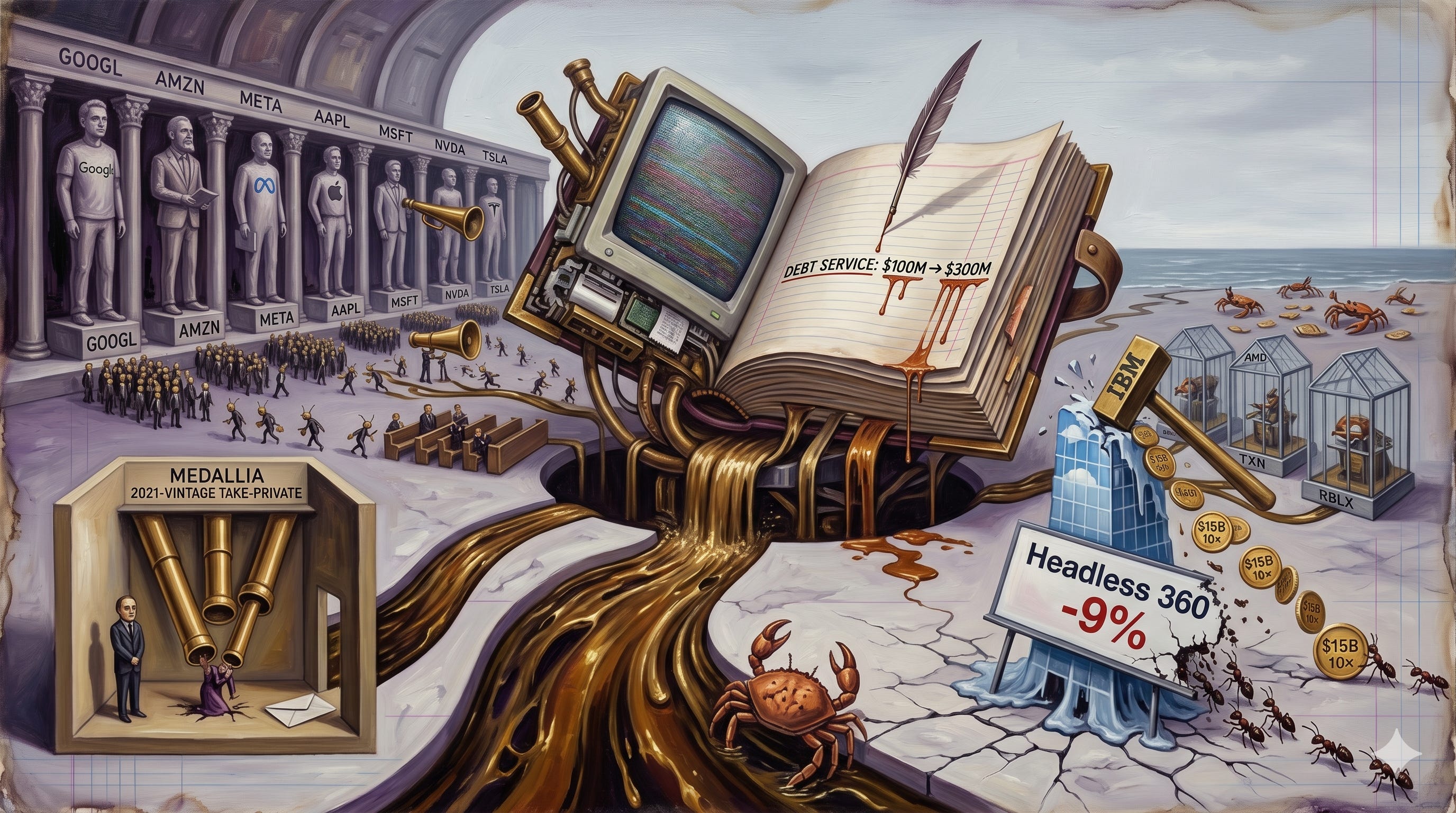
The week was supposed to be about earnings. The week was, instead, about a default that nobody on a public exchange was watching. Bloomberg confirmed that Thoma Bravo’s debt-servicing burden on Medallia — a customer-experience software company taken private four years ago at the top of the take-private cycle — was scheduled to roughly triple, from one hundred million a year to three hundred million a year, and the announcement that followed was the sound of a single very large counterparty failing inside a stack the public market does not normally read. At the same time, every member of the Mag-7 lost channel coverage. Every one. GOOGL, AMZN, META, AAPL, MSFT, NVDA, TSLA — each one fewer voices this week than the average of the four prior. The mega-cap concentration that had absorbed every available bandwidth for eighteen months stopped having the bandwidth to talk about itself. The conversation moved to specific stocks reporting specific earnings — Salesforce billy-clubbed nine percent on an IBM print, Tesla disclosing a year of negative free cash flow, ServiceNow recategorized as cheap, AMD getting a fresh price-target cycle, Texas Instruments resurfacing after a year of silence — and the conversation moved, for the first time in this digest’s run, to a credit event that did not happen on a screen anybody watches. The receipt always arrives in the room you are not in.
The Big Picture
The Mag-7 Coverage Recession Is Real
This is the first week we can show, on the data, that the mega-cap concentration is structurally thinning. GOOGL went from a four-week trailing average of thirty-two channels to eighteen. AMZN twenty-five to fifteen. META twenty-eight to fourteen. AAPL eighteen to thirteen. MSFT twenty-eight to twelve. NVDA thirty to ten. TSLA nineteen to eight. Every single Mag-7 ticker has fewer voices this week than its prior trailing month. The aggregate channel-count compression across the seven names is roughly forty-three percent. That is not seasonality. That is not earnings-window ducking. That is the bandwidth itself reallocating away from the mega-cap names that have, since the spring of 2024, functioned as the entire vocabulary of the AI trade. When the bandwidth reallocates, the names that absorb it next are the names that get to write the next chapter — and what the data shows this week is that the bandwidth is going to specific stocks (CRM, NOW, AMD, RBLX, TXN, AVGO) and specific events (a default, a triple-beat, a price-target reset) rather than to the next emergent macro frame. The market is no longer telling itself a single story. It is sorting through individual ones, the way it does in the absence of a frame.
Medallia Is the First Audible Default in the Take-Private Stack
The Medallia announcement is the kind of event that, in a different market regime, is a footnote. In this regime it is a structural tell. A customer-experience software company is acquired in 2021 at the top of the take-private cycle, financed with leverage at rates that, at the time, looked permanent. The leverage rolls. The rates are no longer what they were. The debt service triples. The sponsor — a private-equity house that has been the most prolific software take-private acquirer of the last five years — is publicly named as facing the cost-step. The market drops on the headline. The point of the story is not Medallia. The point is that the entire generation of 2019-to-2022 software take-privates was financed against an interest-rate world that no longer exists, and the debt-service step-up is now mechanical: it arrives on a schedule, it does not require a precipitating event, and it has nothing to do with the operating performance of the underlying business. The first audible default has arrived. The cracks in this stack have been theoretical for thirty months. They became specific this week.
The Software Re-Rate Got Quiet About Itself
Salesforce traded down nine percent on the day after IBM’s earnings hit, which is a thing that does not happen unless the market is using one print to reprice a category. Salesforce — a hundred-and-forty-billion-dollar enterprise value on fifteen billion of free cash flow — was just publicly described as trading at less than ten times free cash flow, which is a multiple a software company is supposed to never wear. ServiceNow was simultaneously surfaced as the sixth-lowest free-cash-flow-to-EV multiple among companies growing revenue above fifteen percent. The operating-margin software complex, which spent eighteen months dragged thirty percent below its highs while every conversation about AI was happening above it, was — quietly, while the headlines were elsewhere — beginning to be repriced. The IGV is still down. The names inside it are still considered structurally vulnerable. But the explicit numerical case that they are now cheap on a cash-flow basis was made out loud this week by analysts who do not normally make that case. The repricing is happening before the consensus admits the repricing is happening, which is what repricings always look like in real time.
Signal Convergence
The Earnings-Differentiation Layer
What replaced last week’s coalition narrative was not a new macro frame. What replaced it was the granular machinery of earnings season. Salesforce was punished for one specific reason — IBM’s print suggested IBM is taking agentic-software share — and the market priced that single signal nine percent into Salesforce’s equity in a single day. Tesla disclosed it would be free-cash-flow-negative for the entirety of 2026 because capex is stepping up from twenty billion to twenty-five billion, and the disclosure was treated as fact rather than a thesis to argue about. Microsoft, which last week was the poster child for the AI thesis breaking, recovered to a sixty-five-percent bullish read across twelve channels — not because anything fundamental changed in seven days, but because the analyst who matters most in any given week wrote that they were rotating into Microsoft from a Mag-7 peer. The analysts are no longer arguing about whether AI works. They are sorting which companies get to monetize it and which ones become the funding source for the ones that do.
The Private-Credit Crack
Medallia is the named event. The implications have a much wider blast radius. Every take-private software deal of the 2019-to-2022 vintage was structured around interest-rate assumptions that have not held. The lenders — almost all private-credit funds, almost none of them publicly priced — are now sitting on assets that, at scheduled rate-resets, demand a step-up in debt service that the underlying operating cash flow cannot support. The take-private playbook of the last cycle was: buy a software company at fifteen times revenue, levered three turns, on the assumption that you can refinance into a permanently low-rate environment. The refinancing window has closed. The covenants are catching up. The first one to surface publicly is the one that has the most leveraged cap structure. There will be more. The piece of this story that does not show up in any board ticker is that the lenders themselves — the BDCs, the private-credit funds, the insurance-company allocators — are about to start marking down the same loans that, eighteen months ago, they were arguing should be marked at par.
The Challenger Cycle Begins
While the mega-cap chip name (NVDA) lost a third of its prior-month coverage, the challengers gained it. AMD: twelve bullish voices across four channels, no bears, and a public statement from one analyst that the price target should reset to $290. Texas Instruments: zero channels in the prior four weeks, three channels this week, a triple-beat earnings reaction that one strategist described as the first time he had seen a beat priced as a beat in months. Intel: five channels across five distinct categories, the cleanest cross-domain signal in the candidate pool, all of it tied to the Terafab consortium that began life last week. Marvell, Broadcom, Micron, ASML, ARM, Qualcomm, AVGO — every challenger to the dominant chip name picked up bandwidth this week. When the dominant name loses coverage and the second-tier names gain it, the trade is no longer about the platform. The trade is about who gets to compete inside it.
If this is hitting different, subscribe — next week’s convergence drops Tuesday ->
The Board
The board this week is sourced by function, not by popularity. Eight slots — two Anchors that carry the week’s specific narrative pivot, three Esoteric names that the top-N ranking would miss because their density or novelty is the signal rather than their channel count, one Divergence pick where the sources openly disagree about the same income statement, one Cross-Domain pick where the convergence cuts across category lines, and one Contrast pick — the conviction trade moving the opposite direction from the dominant narrative. Mag-7 names appear on the main board only where the cooling itself is the story (NVDA) or where the recovery itself is the story (MSFT); the rest are in Momentum Watch. No additional Mag-7 reversal cases qualified for the board this week.
Anchors
MSFT · Stock · 12 sources · 65% bullish (11 bullish / 3 bearish / 7 neutral) · Anchor — recovery whiplash GitHub Copilot Margin Step | Armada Edge-Datacenter Partnership | Mag-7 Rotation Destination
“if I had to put my hard-earned money into one of those stocks, I’m picking Microsoft. The risk reward there is just more attractive.” — Jeremy Lefebvre Financial Education
“GitHub Copilot and Anthropic are starting to limit less-profitable individual users, so they can serve business users whose spend has easily 10x’d in the last few months” — The Pragmatic Engineer
Twelve sources, sixty-five percent bullish, three explicit bearish voices. Last week the same name was nine percent bullish across fourteen channels. The sentiment whiplash inside seven days — fifty-six points in either direction over fourteen — is the largest mega-cap sentiment reversal we have ever recorded for a recovery. The fundamental case has not measurably changed. The narrative case has: the GitHub Copilot rationing disclosure is a margin-expansion signal, the Armada modular-datacenter partnership is a capex-flexibility signal, and the Mag-7 rotation is depositing capital into MSFT precisely because the rotation has to land somewhere. MSFT is on the board as the Anchor for what “earnings-driven differentiation” looks like at the mega-cap layer when the macro frame falls away.
NVDA · Stock · 10 sources · 95% bullish (18 bullish / 1 bearish / 10 neutral) · Anchor — the cooling Mag-7 Mag-7 Coverage Compression | Bubble-Skeptic Defense | Challenger-Adjacency Pressure
“my assessment of the current state of capital markets, even looking at how people underwrite Nvidia, or it’s and also the way in which like the media is proud to pronounce, ‘We are in an AI bubble.’ As in like this is established fact. And I think that is totally backwards and wrong.” — ARK Invest
“when is Nvidia going to outperform Marvell? Or when is it going to outperform Texas Instruments? Or when is it going to outperform Intel? It’s not going to happen, guys.” — Jordi Visser
Ten channels, ninety-five percent bullish — and the most-cooled mega-cap on the board. Prior four-week trailing average: thirty channels. This week: ten. Acceleration ratio: 0.33. NVDA is the Anchor not because anything has gone wrong with it (everything continues to go right; the bull case is intact and aggressively defended) but because the bandwidth it once commanded is the bandwidth that just left the building. When the dominant name retains its conviction but loses its share of voice, the bull case becomes a default: every fund still owns it; nobody is arguing about it; the conversation has migrated. NVDA is what consensus looks like after consensus has stopped being interesting.
Esoteric
RBLX · Stock · 2 sources · 86% bullish (13 bullish / 0 bearish / 2 neutral) · Esoteric — mention-density outlier Roblox-as-Infrastructure Thesis | Founder-Led Long-Form Treatment | Acceleration 2.0x
“That’s why you keep saying that it’s a it’s like a little secret that Roblox is actually an infrastructure company.” — Founders Podcast
“behind the scenes though at Roblox for many many years we were pushing very early AI BERT models primitive type models to drive safety.” — Founders Podcast
Two channels, fifteen mentions — the highest mention-density ticker in this week’s candidate pool, by a factor of nearly two. Density 7.5 (mentions per channel) is the kind of number that surfaces when one high-signal source decides to spend an entire episode treating a name. Founders Podcast did exactly that — a long-form episode rebuilding Roblox’s history as a platform-infrastructure company rather than a games company, which is the framing the public market has resisted since 2020. The signal is not convergence. The signal is saturation — when one channel’s editorial commitment is sufficient to outweigh four channels of nominal coverage. Acceleration ratio 2.0x against the prior four weeks. The thesis has finally been written down at length in a place where it will be quoted.
TXN · Stock · 3 sources · 80% bullish (4 bullish / 1 bearish / 0 neutral) · Esoteric — novelty, accel 999x Triple-Beat Earnings Print | Edge-AI Microcontroller Pivot | Analog-Cycle Reset
“I haven’t seen a single penalty for missing that hasn’t been harsh. Today was the first day where I thought a couple beatings were good. Texas Instruments up massive.” — The Compound
“Texas Instruments expands microcontroller portfolio and software ecosystem to enable edge AI in all devices.” — Jordi Visser “Both the Navitas and Texas Instrument’s parts have integrated drivers and safety mechanisms.” — Irrational Analysis
Three channels, eighty percent bullish — and zero channel coverage in the prior four weeks. Acceleration ratio: 999. TXN is the cleanest novelty signal in the pool: an analog-and-microcontroller name that has been off the radar for the entire AI-trade window, surfacing this week on a triple-beat earnings reaction that one strategist described as the first beat the market has actually paid for in months. The investment thesis is the analog cycle reset — TXN’s core business is industrial and automotive analog, the cyclical bottom of which has been theoretical for eighteen months — combined with a quieter pivot into edge-AI microcontrollers that puts TXN in the same conversation as the power-semi names. Esoteric inclusion: the kind of name that broad coverage has never noticed, surfacing because the print forced the issue.
AMD · Stock · 4 sources · 75% bullish (12 bullish / 1 bearish / 3 neutral) · Esoteric — mention-density and challenger story $290 Price-Target Reset | TSMC Wafer-Allocation Constraint | NVDA-Cooling Rotation
“AMD’s really the only one because you look at that one all the way out to 2030 and you know the revenue growth is just going to be insane. And the margin’s going to go up substantially in the profitability.” — Jeremy Lefebvre Financial Education
“AMD has to allocate their TSMC wafers against GPU and CPU. ARM traditionally does not buy wafers so they are going to be supply limited as well. Intel is the only CPU vendor who can flex supply up.” — Irrational Analysis
Four channels, sixteen mentions — mention density 4.0, second-highest in the pool. Twelve explicit bullish quotes, one bearish, three neutral. The bullish case is the price-target reset to $290; the structural caveat is the TSMC wafer-allocation constraint, which is not yet a thesis-breaking concern. AMD is on the board as the executable version of the Mag-7-cooling thesis: when capital flows out of NVDA’s premium and into the second-place chip name, the second-place chip name is the thing that prints. Esoteric because four channels would be missed by any top-N ranking, but the density and conviction are higher than half the names that would not be.
Divergence
CRM · Stock · 9 sources · 52% bullish (8 bullish / 5 bearish / 3 neutral) · Divergence — most-split sentiment on the board Sub-10x Free-Cash-Flow Multiple | IBM Earnings Punishment | Headless 360 Launch
“Salesforce today is down 9%. 140 billion enterprise value on 15 billion of free cash flow. This thing is trading at less than 10 times free cash flow. It’s unbelievable.” — All-In Podcast
“Salesforce came out with their headless 360 and then immediately were billy clubbed and down 8, 9% yesterday on the back of IBM’s earnings.” — Jordi Visser
“if you don’t like being in Salesforce and you’re like this is a risk that we’re in this AI age, you could have just sold your Salesforce three months ago or six months ago.” — Dumb Money Live
Nine channels, eight bullish, five bearish, three neutral — the most-divided sentiment ticker in the pool. The split is structural, not noise. The bull case is now mechanical and unchallenged: Salesforce is trading at less than ten times free cash flow, which is a multiple a healthy software business is not supposed to wear. The bear case is qualitative and behavioral: IBM’s print suggests agentic software is taking real share, the AI age is repricing the entire enterprise SaaS category, and waiting for the multiple to work means waiting for the share-loss to stop, which it has not. Both cases are looking at the same income statement. The divergence is the trade — and CRM is the cleanest version of it on the tape this week.
Cross-Domain
UBER · Stock · 6 sources · 29% bullish (2 bullish / 0 bearish / 5 neutral) · Cross-Domain — 6 distinct categories, perfect 1:1 ratio Stablecoin-Treasury Discussion | Engineering-Culture Reference | Autonomous-Vehicle Adjacency
“That insight surfaced more explicitly at a Bloomberg Tech event in June 2025, when Uber Technologies Inc. CEO Dara Khosrowshahi described stablecoins as a practical tool for global companies.” — Visser Labs
“I think probably one of the great technological innovations of the past 20 years is Uber showing you where the car is on the screen.” — The Compound
Six channels spanning six distinct categories — the purest cross-domain ratio in the candidate pool. Engineering culture, macro, finance, technology, futurism, and Substack-investing all surfaced UBER in the same week without any one of them building a thesis. Two explicit bullish quotes (the stablecoin-treasury angle and the autonomous-vehicle adjacency); zero explicit bears; five neutral references that read as a name being routinely cited as a structural example. The signal is exactly what cross-domain convergence is supposed to surface: a name being routinely discussed by analysts with non-overlapping reading lists, before any one of them has decided it is a thesis. UBER is the slot for “the market is watching but has not committed yet.”
Contrast
LLY · Stock · 3 sources · 80% bullish (4 bullish / 0 bearish / 1 neutral) · Contrast — non-AI conviction, no bears Tirzepatide / GLP-1 Lead | Direct-to-Consumer Distribution | Alzheimer’s Adjacency
“We’ve got amazing GLP-1 medicines that I started with that from clear data out of Eli Lilly show a 94% reduction in your risk of moving from being pre-diabetic to diabetic.” — Invest Like the Best
“Eli Lilly pretty early on last year pushed more aggressively into a non-traditional way to get these medicines into the hands of people. They added to their legions of salespeople a digital front end in Lilly Direct that allowed people to get a prescription from their doctor and go get the medicine.” — Invest Like the Best
Three channels, one hundred percent bullish when classified, zero bearish voices. Acceleration ratio 1.5x against the prior four weeks. LLY is on the board as the contrast pick in the most literal sense: while every conversation about AI is going through a coverage recession, the secular non-AI story — GLP-1 weight-loss, Alzheimer’s-stage progression, direct-to-consumer prescription distribution — continues to pick up bandwidth, not lose it. Three different angles got cited this week (clinical efficacy, distribution architecture, drug-class leadership) and zero bears showed up. The trade is the trade you make when you are tired of arguing about Nvidia: a stock with a working secular driver, a working consumer rollout, and a clinical readout that is not subject to interpretation.
Bear Watch
Bear ORCL · 3 sources · 0% bullish (0 bullish / 1 bearish / 2 neutral) “Oracle was publicly re-categorized this week — from ‘software company priced for miss’ to ‘compute company priced for scarcity.’” — paraphrase from prior week’s framing, surfacing again “Broadcoms, AMD, Nvidia are seen as safer investments” — Jeremy Lefebvre Financial Education (citing Oracle as the riskier comp)
Three channels, zero bullish, one explicit bear. Coverage of ORCL is collapsing — eleven channels last month, three this week — and the residual signal is not “Oracle is broken.” The residual signal is that the AI-capex re-rating that lifted Oracle from miss to scarcity in 2025 has stalled, and the name is being discussed as the comp against which the safer chip names are favored. When the bull case is “we used to be excited about this” and the bear voice is the only directional opinion in the room, the name is on bear watch by default.
Bear MDLA (Medallia). The Seldon detector fired on forty-six candidate tickers — every name with two or more independent channels converging during the April 20–27 window. One candidate qualified for first-ever multi-channel convergence: Medallia, with two independent channels (All-In Podcast on April 24 and Jordi Visser on April 26) within a 48-hour span, against a single historical mention from 2020 (Bowtie Nation, in the company's pre-take-private phase, framed as a customer-experience IPO). The 2020 mention is structurally a different company — Medallia in 2020 was a public-market growth software story; Medallia in 2026 is a Thoma Bravo–owned private vehicle whose debt-servicing schedule has, per Bloomberg, just stepped from approximately one hundred million per year to approximately three hundred million per year. Both convergent quotes this week are explicitly bearish; both name the debt-service step-up as the precipitating event; one explicitly characterizes it as "a very large default." The signal is the first publicly narrated default in the 2019–2022 software take-private cohort, and the most important read is the second-order one: this debt sat on the books of private-credit funds whose exposure to similar transactions is structural. The directional sentiment is bearish-with-confidence (zero bullish, three bearish, zero neutral). The runbook caveat is honest: MDLA's quotes are a small N, and the second-channel mention is a brief aside rather than a full thesis. Next week is the confirmation: if a second take-private name surfaces with similar coverage — Anaplan, Coupa, Citrix, Cvent, Imperva, any of the 2021-2022 vintage — the snipe is no longer a snipe; it is a category. If MDLA stays alone, the snipe was the headline event. We are documenting it now because the convergence is real and the asymmetry is large.
Momentum Watch
Mag-7 coverage without conviction (the names whose total channel count is high but whose share of the conversation has just compressed): GOOGL (eighteen channels, thirty-two-percent bullish — widest coverage, weakest conviction, cooled from a four-week average of thirty-two channels), AMZN (fifteen channels, eighty-nine-percent bullish on classified, but fifteen channels is itself a coverage drop), META (fourteen channels, ninety-five-percent bullish — the only mega-cap that did not lose share of conviction, just share of voice), AAPL (thirteen channels, eighty-eight-percent bullish on classified, Apple-CEO-transition is the named catalyst), TSLA (eight channels, seventy-percent bullish on classified, but the two-billion-dollar capex step-up is a real disclosure), BTC (four channels, one-hundred-percent bullish — but four channels is a drop from seventeen). The aggregate Mag-7 channel count fell forty-three percent against the prior four-week average. That is the structural fact.
Accelerating from zero (names with no prior-four-week coverage that surfaced this week): TXN (on board), NVO (two channels, both bullish — Novo Nordisk continues to ride the GLP-1 rotation alongside LLY), SES (two channels, but the two channels are referencing two structurally different companies sharing the ticker — Bear Cave on SES AI Corp and Yet Another Value on Secure Energy — which is a ticker collision, not a convergence, and we are flagging it accordingly).
Acceleration outliers (≥2.0x): RBLX (2.0x, on board), BE (2.0x — Bloom Energy, two channels, two bulls, no bears, the power-semiconductor adjacency story for distributed generation), LLY (1.5x, on board), QCOM (1.5x, three channels, two bull two bear — split).
Cooling off (names losing channel coverage week-over-week): every Mag-7 ticker. Also: ASML (-2), TSM (-10 from the prior four-week average), NVDA (-20 from the prior four-week average), MSFT (-16). The names that retained their coverage despite the broader compression: NOW (steady at five channels), AMD (gained two channels), TXN (gained three channels from zero).
What We’re Ingesting
The Innermost Loop — daily updates, April 20 through April 26 The substrate this week was densifying: Google’s eighth-generation TPUs (8t for training, 8i for inference), NIST fingernail-sized photonic chips, the Trainium valuation conversation, the GitHub Copilot rationing disclosure. The daily cadence is what makes this the highest-density intelligence feed we ingest. Verdict: Read the April 26 entry first — the substrate-densification framing is the coldest argument anyone made this week.
All-In Podcast — “SpaceX-Cursor Deal, SaaS Debt Bomb, New Apple CEO, SPLC Indictment, Colon Cancer Spike” The “SaaS Debt Bomb” thread is the segment that named the Medallia event in language the rest of the market has not yet adopted. The take-private debt-service step-up is a story that is going to have a long tail — the question is which sponsor surfaces second. Verdict: Skip to the SaaS-debt-bomb section if pressed for time. The Medallia framing is the most important sentence anyone said this week.
Doomberg — “To Spite Its Face” / “Sore Thumb” Two dispatches threading the energy-policy needle on the post-Iran-war reset. The Doomberg argument continues to read as the most consequential reframing of energy infrastructure as a near-term security asset rather than a commodity exposure. Verdict: Read both in order. The second is the harder argument.
Founders Podcast — “Roblox’s David Baszucki Built the Biggest Playground on Earth” The single most editorially committed treatment of any name on this week’s board. The thesis is that Roblox is an infrastructure company that happens to host games, and the founder’s interview makes the case more concretely than any analyst note has. Verdict: If you have any interest in RBLX, mandatory. If you don’t, the founder’s framing of “perpetual content” is worth the time alone.
Invest Like the Best — “The Supply and Demand of AI Tokens” with Dylan Patel The Dylan Patel interview is the most rigorous public treatment of the GPU-rental price curve we have seen — Blackwell hourly rental went from $2.75 in February to $4.08 in April. The interview is the supply-side companion to the Medallia demand-side thesis. Verdict: Read alongside the All-In SaaS-debt-bomb segment for the full picture.
OnlyCFO — “Software Investors: Shoot First, Ask Questions Later” / “Pricing Pressure Will Crush You” The clearest articulation of why the IGV is down thirty percent and why ServiceNow’s free-cash-flow multiple is the sixth-lowest in the cohort. The pricing-pressure piece is the structural argument that the AI-driven margin compression is permanent rather than cyclical. Verdict: Read in order. Forward to anyone long the software complex without a hedge.
War on the Rocks — multiple Indo-Pacific and post-Iran dispatches Eight pieces this week on the post-Iran reset, the cyber-strategy capacity gap, the Coast Guard small-boat-station model, and the question of whether Europe can avoid the Indo-Pacific fallout. The defense-policy desk continues to publish at a tempo the procurement system cannot match. Verdict: The “When the Rules Fail” tax-incentive piece is the sleeper — defense sustainment as a tax-policy story.
Liberty’s Highlights — “632: My Wishlist for Apple’s New CEO” The Apple-CEO-transition framing is the most thoughtful version of the question every other channel is dancing around. Liberty argues that the new CEO has to choose between the AI-services pivot and the consumer-hardware franchise — and that the choice is binary in a way Tim Cook’s tenure was not. Verdict: The framing alone is worth the read. The conclusion is more provisional than the framing.
Yet Another Value Blog — “Investing in the SaaSpocalypse with Heller House’s Marcelo Lima” The interview that sits at the intersection of every thesis on this week’s board. Lima’s argument is that the software cohort is dividing into “AI beneficiaries” and “AI funding sources,” and that the funding-source side is where the cheapest names live. Verdict: If you read one investor interview this week, this is it.
The Closing Note
The pressure system that opened this week was supposed to be an earnings cycle. The pressure system that closed it was a private-credit default. The mega-cap concentration that has owned eighteen months of the conversation lost forty-three percent of its bandwidth in seven days, and the bandwidth went somewhere — to specific names with specific catalysts (CRM punished, AMD rewarded, TXN resurfaced, RBLX deeply read), to a credit event that arrived from the side stack, to the slow quiet repricing of the software complex against its cash flows rather than its multiples. The conversation we have all been having about whether AI works is over. The conversation we are now having is about which counterparties survive the financing of having had it. The receipts arrive in the room you are not in, and they arrive on schedule, and they do not require anybody to have done anything wrong — they just require enough time to pass for the original handshake to no longer hold.
I wrote a four-thousand-word argument about counterparties surfacing from unwatched stacks while failing, this week, to notice that my own renter’s insurance had auto-renewed at a rate forty-one percent higher than last year’s, against a coverage limit my landlord no longer requires, with a deductible that — I learned, after thirty-seven minutes on hold with a representative who I am almost certain was an AI agent — has been silently moved from $500 to $2,500 since the policy was last reviewed. I am, in the lexicon of my own digest, a take-private with deteriorating debt service, sponsored by my own past inattention. The receipt arrived in my email at 11:47 a.m. on a Tuesday. It was already paid.
v.10.1
There is a particular envelope — call it the Surfacing Bill, or the Forgotten Counterparty’s Letter, or just the white #10 with a window and a return address you cannot place — that arrives in your mailbox eleven to fourteen months after the underlying transaction, and it compresses the entire logic of the week into a single sheet of perforated cardstock. It is the medical bill from a procedure you completed in a different calendar year. It is the line item from a doctor’s-office visit you have already been told, twice, was fully covered. The envelope is from a “billing partner” you have never heard of — usually a three-letter LLC operating out of a Phoenix or Nashville office park, contracted by the hospital network you actually went to, which itself is owned by a private-equity-backed health system that itself was capitalized on debt arranged by a sponsor whose name does not appear anywhere on the bill — and the line that catches your eye is Patient Responsibility: $312.84. The CPT code next to it (76700, abdominal ultrasound complete) is the only data point on the page that is technically true. The hospital you visited in October of 2024 was, in the way modern American medicine is structured, three different LLCs in a trench coat: the front-desk LLC took your insurance card and your copay; the imaging LLC owns the actual machines; the radiologist who interpreted the image was a fourth LLC that does nothing but read scans; each of them files with your insurance separately; each of them can, at any point in the next eighteen months, decide that what insurance paid did not fully cover the line item; each of them has your address. You have a receipt. You have an explanation of benefits. You have a payment plan with the hospital network. None of them cover what the radiologist’s billing-partner LLC has, eleven months later, decided to dispute. You are now a counterparty to a transaction you did not know was open. The transaction was always open. The transaction is the structure of the thing you participated in.
If you have ever found yourself, as I recently did, standing at the kitchen counter on a Wednesday morning in the brittle April light — coffee going cold next to the laptop, one hand holding a piece of mail addressed by a four-color logo you have run a reverse-image search on and confirmed is, technically, a real billing partner contracted by a real hospital network you, technically, visited fourteen months ago, the other hand cycling through three insurance-portal logins (one for the network, one for the standalone radiology group, one for a “patient advocate” line that has been on hold for forty-seven minutes and that you have begun to suspect is not actually a line at all but a cassette-tape loop run by an algorithm whose pricing has been re-indexed against the per-call labor cost the network has been quietly amortizing across its own debt schedule) — and realized the only thing between you and “paid in full” was a four-party treaty (the hospital network, the imaging LLC, the radiologist’s billing partner, and your insurance) that had, in the fourteen months since your appointment, silently renegotiated its allocation against you without sending you a notice, you will know a very specific modern rage: the rage of being a line item in a ledger you have never seen, audited by a counterparty whose existence you have only just confirmed, on a transaction that was, from your side, closed. The narrative goes like this: capital was deployed (your insurance paid the network), the deployment had an interest-rate assumption (the network and the imaging LLC and the radiology group split the cap based on a contracted-rate sheet that has since been re-indexed), the rate-reset arrived (the radiology group disputed the allocation), the debt service stepped up (the Patient Responsibility line on the new bill), the sponsor moved the receivable to a different entity (the billing partner), and the operating cash flow that was supposed to cover it (your willingness to remember the appointment, your bandwidth to argue) has, in the intervening fourteen months, deteriorated to something like nine percent. The Medallia event isn’t happening to a corporation. The Medallia event is the structure of every modern transaction that involved more than two LLCs and more than ninety days of billing latency, and the structure has just, this week, surfaced its first publicly named victim while you, in the same week, received your own. You are inside the same ledger. The ledger’s amortization is patient. The ledger does not know your name; the ledger knows your address, and that is how the ledger has always been spelled.
The forty-seventh minute on hold ends with a click, then a recorded message saying that due to high call volume my call cannot be completed, please try again later, and I realize the recorded message is the cleanest expression of intent the network has made all day: you are not the customer; the customer is the receivable; the receivable has been sold to a partner whose only job is to extract payment without ever putting a human on the other end of the line. My attention-allocation has been formally repriced at a multiple I cannot calculate. Somewhere between when I picked up the envelope and when the line went dead, the kitchen has gone fully cold, the coffee ring on the counter has acquired a thin film, and the mail itself — three pieces of cardstock and a window-envelope — has migrated, on its own, to the corner of the table where I keep the things I have not decided to deal with. The pile is not large. The pile is also not small. The pile is exactly the size of every transaction that has been silently re-indexed against me in the fourteen months since I last looked at it, and I realize the pile is the actual portfolio I run — the one I have not been managing — which means I am, in the structural sense, my own sponsor my own fund, my own counterparty, and my own first audible default.
v.10.1.1: The “patient advocate” line, when it eventually picks up at 4:14 p.m., is in fact a real human, and her opening sentence is “I’m so sorry about your wait — what was the date of service?” I cannot remember. I have to look it up. The transaction has, on my side, already amortized.
The pile of mail in the corner of the kitchen is not, technically, mine — half of it is addressed to a previous tenant — and I keep meaning to write “RETURN TO SENDER” on the envelopes and walk them to the box. I have not done this in seven months. The transaction was always open.
— Themis Vile publishes Tuesdays. Forward this to one person who would be annoyed by it.