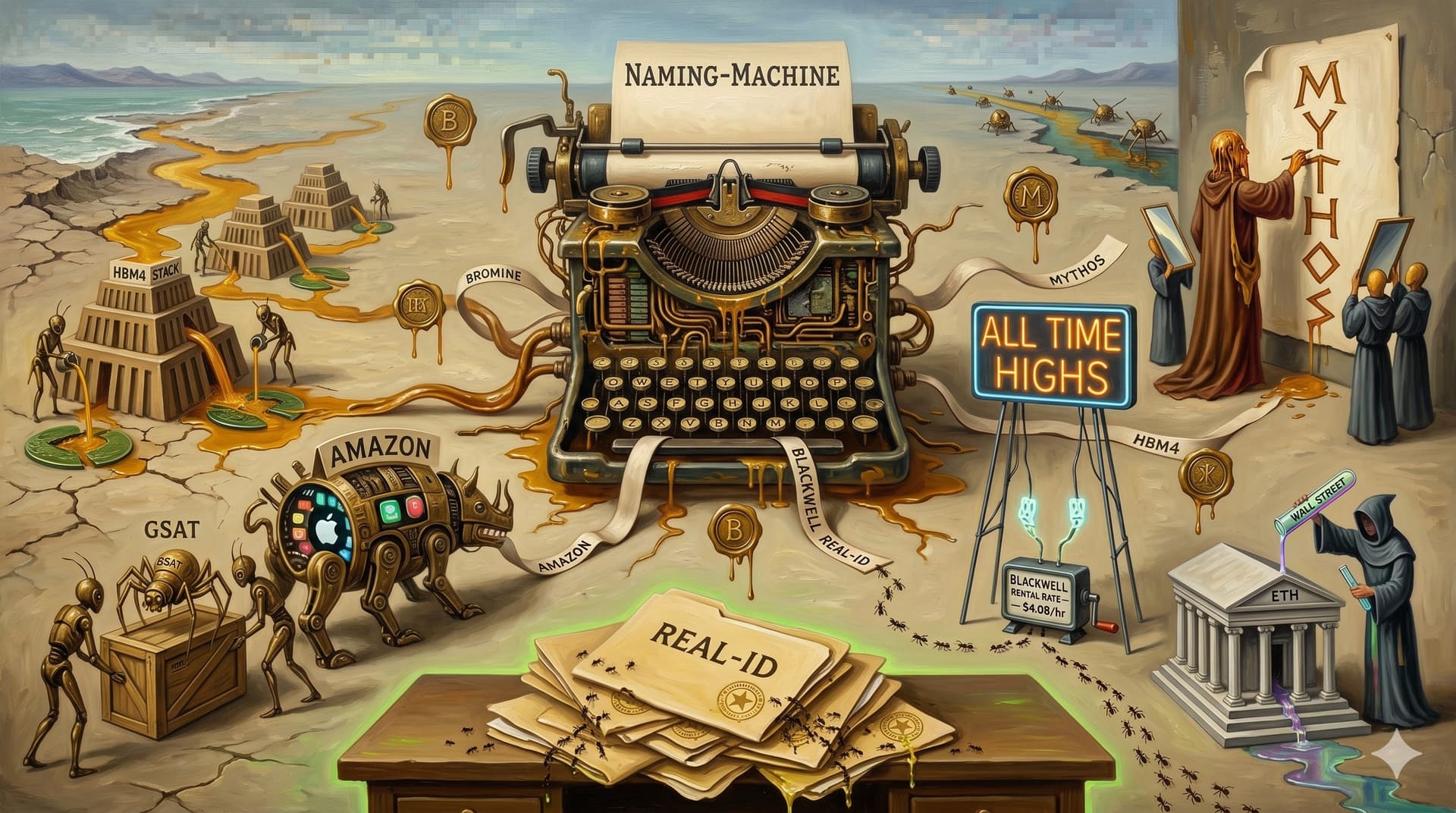
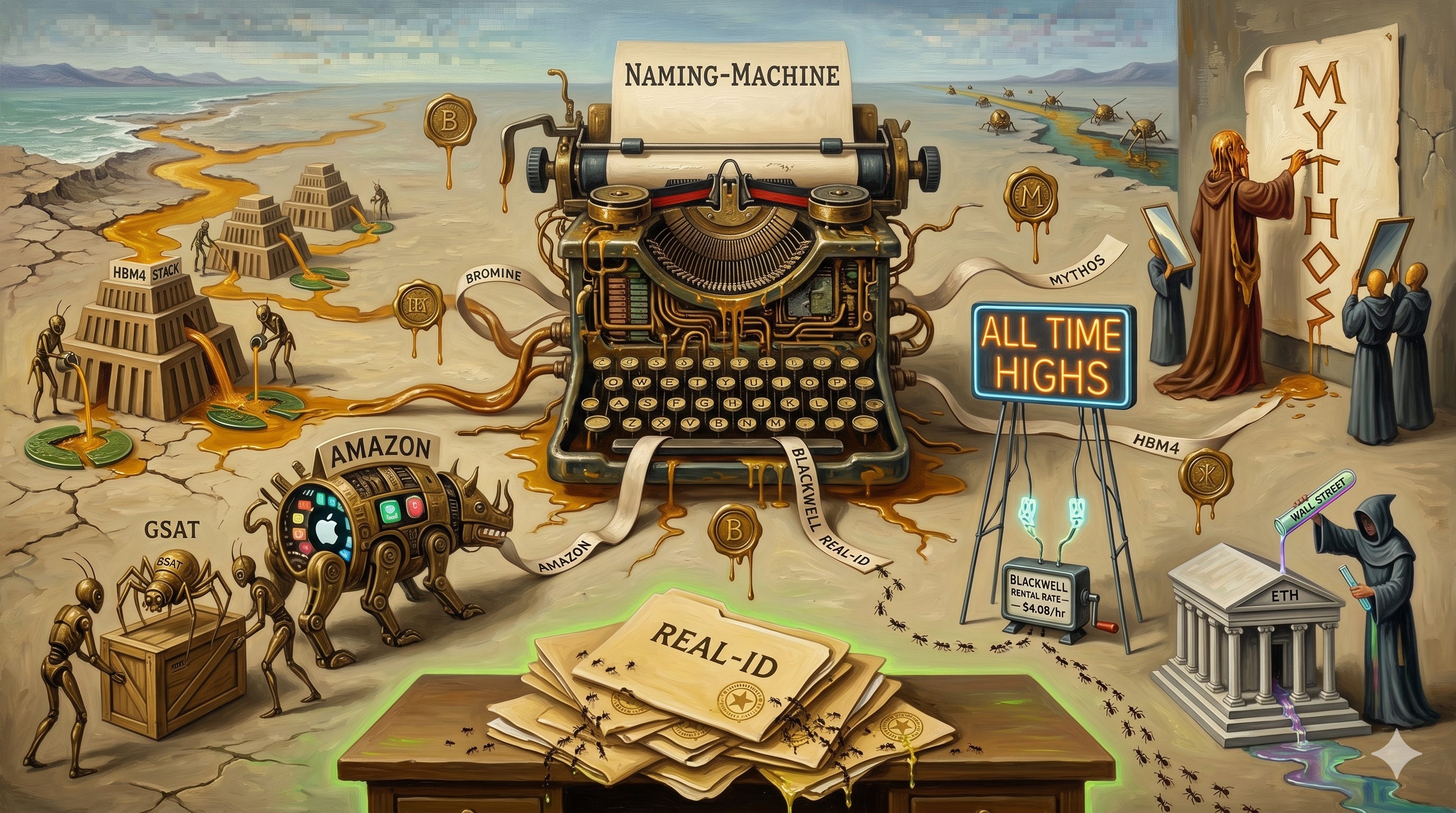
The coalitions signed last week started producing their first specific casualties this week, and the casualties had names. A defense-policy dispatch identified bromine — a halogen sourced, in global volume, through a shortlist of facilities clustered around the Dead Sea and Shandong province — as the single upstream chemical on which every DRAM, NAND, and HBM4 etch step silently depends. A macro fund published a research note whose title said the quiet part aloud: All Time Highs Built On A Compute Shortage. Amazon paid $11.57 billion for a satellite company most analysts had treated as a curiosity, and the company turned out to already be inside every iPhone Apple has shipped since 2022. An AI-safety framework acquired a mythological codename — Mythos — and the codename became a negotiating frame before it was a specification. Ethereum was publicly re-baptized as “one of the greatest assets I’ve ever seen” by the kind of macro strategist who does not generally baptize things. The constant, this week, is not the pressure. It is that the pressure has started introducing itself by name. Last week’s scarcity was a macro abstraction. This week it has proper nouns, line items, and, in several cases, tickers.
The Big Picture
The Bromine at the Center of Your Phone
The bromine-chokepoint argument is the sharpest specific catastrophe the week produced. Global brominated-flame-retardant supply runs through a handful of facilities concentrated in the Dead Sea basin and Shandong province, and the etch chemistry used in DRAM, NAND, and HBM4 manufacturing carries brominated intermediates downstream of that supply at every step. A Hormuz closure cascades, not immediately into oil, but — within three to six months — into a memory-supply cliff that nobody has a contingency drill for. The semiconductor industry has a thick playbook for EUV lithography exposure (ASML is the named risk, TSMC is the named concentration, Arizona and Kumamoto are the named relocations). It has nothing remotely equivalent for etch chemistry. The bromine piece is what happens when a structural single-point-of-failure gets its first mainstream technical writeup. It is also, not coincidentally, the single most concrete reason that Samsung’s 36GB 12-high HBM4 stack announcement at ISSCC this week — a feat of process engineering that took nine years to execute — is being priced as a capability demonstration rather than a pricing breakthrough. The process works. The process needs bromine. Bromine needs a Gulf that the war has not yet closed.
Mythos Is the Regulatory Treaty in a Costume
AI safety acquired a proper noun this week. The Anthropic catastrophic-risk framework — previously known only by SKU-style descriptors, unreleased capability tiers, private Glasswing documents — surfaced publicly as Mythos, and the word is doing work. An alignment regime called “AI Model Safety” is a bureaucratic forum that adversaries negotiate against. A regime called Mythos is a story that adversaries enter. When the regulatory apparatus for catastrophic-risk AI acquires a mythological cover name, the parties being regulated have already negotiated the language of their own regulation. The sequence is specific: frontier labs produce the capability, the frontier labs name the regime, the regime acquires a mythological register, the register pre-empts legislative framing. The futurism newsletters, the technology readers, and the defense-policy desk all treated the naming itself as the load-bearing event of the week. A major hedge-fund brainstorm podcast walked through the framework twice. A long-read circulating on the policy side simply titled itself “Anthropic’s Nuclear Bomb.” The trade is not in a specific ticker. It is in recognizing that a mythological naming convention is now the primary mechanism by which AI policy gets negotiated in public.
The Shortage Has Stopped Being an Euphemism
The most consequential piece of content in the week was a title. All Time Highs Built On A Compute Shortage. For eighteen months the compute-shortage thesis lived inside macro notes as a caveat, a footnote, a “the interesting question is whether supply catches up.” This week it became the headline. Blackwell GPU hourly rental went from $2.75 in February to $4.08 in April — a forty-eight percent increase in sixty days on hourly GPU pricing, which is not a curve any conventional capital-allocation framework is designed to ingest. One futurism newsletter framed it as “the jet fuel inflection point.” A long-form interview pod hosted a Brookings economic-historian to discuss “The Infinity Machine.” Oracle was publicly re-categorized this week — from “software company priced for miss” to “compute company priced for scarcity.” When an asterisk gets promoted to the headline, it stops being an asterisk. The shortage is not a bug. It is not a transient. It is the default frame against which every asset is now being priced, and the names that absorb the scarcity — memory, optical, power, spectrum — are the ones that get written on the treaty instead of the invoice.
Signal Convergence
The Memory Ring
For the first time since 2023, the memory trio — Samsung, Micron, SK Hynix — is being discussed as a single interlocked system rather than three overlapping competitors. The week’s deepest technical writeup threads a Samsung 36GB 12-high HBM4 stack at 3.3 TB/s through Nvidia and Broadcom co-packaged optical engines into TSMC’s Active LSI program, and explicitly notes that the downstream chip customers are hogging upstream fabrication capacity. A separate analyst publishes a twelve-to-eighteen-month long thesis on DRAM as a direct call (”Assume it is safe to be long DRAM — SK/Samsung/Micron — for the next 12-18 months”). A weekly finance show floats Micron as stock-of-the-year candidate mid-conversation. A macro fund names the trio as a single demand-side bottleneck in the same sentence. What were three independent commodity cyclicals are, in the 2026 AI compute stack, now a shared-fate triumvirate with a single set of customers (the hyperscalers who are pre-ordering) and a single upstream dependency (the bromine supply chain described above). The ring is closed. The names are locked.
The Satellite Underdog Now Has a Ticker
The satellite-spectrum war was, until this week, framed as “Starlink versus everybody.” This week the everybody acquired a balance sheet, a price tag, and a ticker. Amazon paid $11.57 billion for Globalstar. The Globalstar infrastructure already powers Apple’s emergency-SOS service on every iPhone 14+ and every Apple Watch Ultra 3 shipped since 2022. The technology readers name the alignment as “Amazon + Globalstar vs Starlink.” The deal’s price surfaces inside a major tech-and-futurism podcast. The strategic rearrangement is that the satellite-backbone war has moved from a spectrum auction into a consolidated two-block structure — Starlink on one side, Amazon-Apple-Globalstar on the other — with Kuiper sitting as the forward deployment and GSAT sitting as the installed base. When a three-year narrative abstraction acquires a line-item acquisition price, it has entered the accounting.
Ethereum Receives Its Institutional Rite
Three channels, twelve bullish mentions, zero bearish, one neutral — the tightest conviction-cluster on the candidate board this week, concentrated inside a single long-form macro-strategist interview titled “Ethereum’s Wall Street Moment Is Here,” reinforced by a separate macro-fund technical breakout call (”Here is Ethereum, which not only broke a trend line, but also took out the highs for March. It also has a weekly buy signal”) and a weekly finance-show follow-on. The institutional macro strategist spending sixty minutes on a podcast explaining why ETH is “one of the greatest assets I’ve ever seen” is not a crypto-insider event. It is a category migration. The signal-shape rhymes with IGV’s thirty-percent year-to-date collapse: the capital that used to be absorbed by the software-beneficiary layer is being redirected into assets with native digital scarcity. The coalitions of last week were about who-gets-to-build. The crypto thesis re-opening this week is about who-gets-to-own.
If this is hitting different, subscribe — next week’s convergence drops Tuesday ->
The Board
MU · Stock · 6 sources · 100% bullish (6 bullish / 0 bearish / 5 neutral) · Anchor — memory scarcity HBM4 Anchor | Bromine Upstream Exposure | Long-DRAM Thesis
“Assume it is safe to be long DRAM (SK/Samsung/Micron) for the next 12-18 months.” — Irrational Analysis
“Taiwan semi, Samsung, Micron would buy he would buy all the chips they can make but their expansion pace is much slower than what he wants.” — Jordi Visser
“Micron was at $85 in August or August of last year. >> $450,” — The Compound
Six channels, one hundred percent bullish among classified, zero explicit bearish voices, and an acceleration ratio of 1.5x versus the prior four weeks. Micron anchors the week not because it is the largest name on the board — it is not — but because it is the name on which the week’s structural thesis hangs most precisely. The Compound floats it as stock of the year. Irrational Analysis publishes the twelve-to-eighteen-month long thesis. SemiAnalysis places its internal CMOS base-die technology inside the HBM4 supply stack at ISSCC. Jordi Visser names it inside the compute-shortage argument as an upstream pricing beneficiary. And the War on the Rocks bromine dispatch, which never mentions MU directly, is the single clearest explanation of why the memory thesis is not a commodity cycle but a structural repricing: the demand is compounding, the supply is geopolitically concentrated, and the bottleneck is chemical before it is lithographic.
NVDA · Stock · 10 sources · 96% bullish of classified (22 bullish / 1 bearish / 18 neutral) · Anchor — scarcity as a feature Blackwell Hourly Pricing | Jensen’s Chip-Supply Tour | Compute-Shortage Thesis
“Jevons’s ghost is already billing customers... renting a single Nvidia Blackwell GPU for an hour now costs $4.08, up 48% from $2.75 two months ago, on agentic AI demand.” — The Innermost Loop
“The prices for Nvidia’s advanced chips were up 48% in two months. You can see the whole thing. And their revenue has gone from 9 billion annualized to 30 billion annualized.” — Jordi Visser
“Nvidia basically seating the market to enable the market is less worrisome because I mean Nvidia’s revenues on on AI like the AI based revenues is going to be hundreds of billions of dollars.” — The Compound
Ten channels, twenty-two bullish voices, a single explicit bearish voice, and eighteen neutral — which in Mag-7 terms is a ninety-six-percent-bullish read on the classified population. Nvidia is the anchor on the “scarcity has stopped being a euphemism” thesis. The Blackwell hourly-rental datapoint (up 48% in sixty days) is the single most mathematically violent pricing curve on the tape this week, and the revenue-expansion datapoint (9B annualized to 30B annualized) is the cash-flow confirmation that follows the price. The one bearish voice is a circular-financing objection that will be the next argument when the multiple cracks — but it is not the argument winning this week. The Anchor case for NVDA is not that the stock goes up. It is that the compute-shortage thesis is now load-bearing across ten independent analyst frames, and NVDA is the cleanest direct expression of it.
GSAT · Stock · 2 sources · neutral (0 bullish / 0 bearish / 2 neutral) · Esoteric — novelty + acquisition catalyst Amazon $11.57B Acquisition | Apple Satellite Installed Base | Kuiper-Globalstar-Starlink Realignment
“Amazon announced a 11.57 billion acquisition of Global Star... and it has a long-term agreement with Apple to be Apple’s primary satellite uh capability for uh its iPhone and and for its Apple Watch.” — peterdiamandis
“Globalstar currently partners with Apple to power satellite service on iPhone 14 or later, as well as Apple Watch Ultra 3, allowing users to text emergency services, message friends and family, request roadside assistance, and share their location.” — Liberty’s Highlights
Two channels, no directional sentiment yet — the analysts are still naming the acquisition, not yet arguing it. GSAT is on the board because the satellite-spectrum war has, in a single eleven-billion-dollar move, changed shape. The narrative that the low-earth-orbit competition was “Starlink versus everyone” got replaced this week by a two-block structure with Amazon-Apple-Globalstar on one side and Starlink on the other. The concrete mechanism — that every iPhone Apple has shipped since 2022 is already using Globalstar infrastructure for emergency SOS — means the acquisition is not a Kuiper bet, it is a consolidation of an installed base. The Esoteric case is that the ticker absorbed a three-year strategic narrative in a single transaction price, and the coverage has not yet processed it.
BAH · Stock · 2 sources · neutral (0 bullish / 0 bearish / 2 neutral) · Esoteric — novelty, accel 999x, first-ever convergence Booz Allen + Andreessen Horowitz Partnership | Defense-Consulting Repositioning | Commercial Consulting Contagion
“Bryce Pippert of Booz Allen and Matt Cronin of Andreessen Horowitz join Ryan to unpack their new partnership” — War on the Rocks
“consulting firms, Accenture, Booze Allen, Gartner, they’re all down 50 to 70%.” — The Compound
Two channels, zero prior-four-week coverage, acceleration ratio of 999x, first-ever two-channel convergence date of 2026-04-15 — the single qualifying Seldon Anomaly of the week. Booz Allen has not appeared on this board’s convergence candidates in the last twenty-eight days. Then War on the Rocks publishes a dedicated podcast on the Booz Allen-Andreessen Horowitz partnership, and The Compound names Booz Allen inside a consulting-sector-is-down-fifty-to-seventy-percent aside on the same day. The two signals are different in kind — one is a repositioning story, one is a sector-collapse story — but they share the thesis that traditional consulting is being bifurcated into “defense-integrated” and “commercially obsolete.” BAH is the name that sits on the defense-integrated side. The thesis-fit on one of the two sources is marginal (The Compound’s mention is part of a list); the sentiment is undirected; the sourcing is limited. All caveated in v.9.2. But the convergence is first-ever.
SSNLF · Stock · 5 sources · 100% bullish of classified (6 bullish / 0 bearish / 4 neutral) · Esoteric — density, HBM4 anchor HBM4 12-High Stack | COP DRAM Process | Bromine Exposure
“By moving the base die to Samsung Foundry’s SF4 logic process, Samsung enables a fully programmable testing framework capable of running complex test algorithms and flexible access sequences.” — SemiAnalysis
Five channels, one hundred percent bullish among classified, zero explicit bearish voices. Samsung is on the board as the HBM4 technology anchor of the memory-ring convergence, not as a pure-play financial thesis — the ADR ticker itself (SSNLF) trades thinly and the directional read is really on Samsung Electronics Korea. The reason SSNLF makes the Esoteric tier rather than the Anchor tier is that the technical engineering density of SemiAnalysis’s coverage is disproportionate to the total channel count. Five of the six explicit quotes on the week are SemiAnalysis technical writeups; the other signal is Jordi Visser’s inclusion in the compute-shortage argument. When the coverage is this technically specific on a ticker that trades this thin, the signal is saturation-of-a-single-high-trust-source, which is exactly what this tier exists to catch.
META · Stock · 16 sources · 60% bullish of classified (9 bullish / 6 bearish / 18 neutral) · Divergence — most-split active sentiment on the board Muse Spark Against ChatGPT | Capex Moderation Debate | Governance Discount
“Thanks to Muse Spark, Meta is back in the race, and they might just get a juicy prize because they don’t have to beat Mythos and Spud at the very tip of the frontier, or even match the full Opus experience, they just have to beat the free version of ChatGPT.” — Liberty’s Highlights
“the big tech companies, Meta, Amazon, Microsoft, Alphabet, and Google, Oracle is on track to spend 720 billion on AI infrastructure in 2026 alone, which is less than 20% of the revenue that they’re making.” — The Diary of a CEO
Sixteen channels, nine bullish voices, six explicit bearish voices — the only ticker on the candidate board with six or more active bears. The split is structural: the Muse Spark / “just have to beat the free version of ChatGPT” argument is pulling one way, the $720B-capex-on-less-than-20%-of-revenue argument is pulling the other. The neutral bucket at eighteen is the largest on the board, which means this is a live debate rather than a settled call. Meta is the name where this week’s “capex moderation” question becomes a direct bet against the scarcity thesis — the bull case requires the capex to moderate, the bear case requires the capex to compound. The divergence is the trade.
GOOGL · Stock · 19 sources · domain_diversity 14 · 87% bullish of classified (13 bullish / 2 bearish / 26 neutral) · Cross-Domain — 14 distinct channel categories SpaceX IPO $100B Windfall | TurboQuant Compression | DeepMind Sovereign-AI Positioning
“Alphabet is poised for a $100B windfall from the SpaceX IPO via its remaining 5% stake after the xAI merger.” — The Innermost Loop
“Google’s TurboQuant compression algorithm, designed to shrink LLM footprints, is now expected by analysts to expand memory chip demand rather than curb it, as cheaper inference begets more of it.” — The Innermost Loop
Nineteen channels spanning fourteen distinct channel categories — the highest coverage and the highest domain-diversity score in the candidate pool. GOOGL is being discussed this week by an AI-research blog, a defense-policy podcast, a VC outlet, a finance vlog, a macro strategist, a futurism newsletter, an engineering publication, an interview podcast, and a geopolitical substack simultaneously. The cross-domain signal is real: Alphabet is being priced as a general-purpose answer to “if not Anthropic, then who?” while simultaneously absorbing a prospective $100B SpaceX IPO windfall and shipping the TurboQuant compression algorithm that re-energizes the memory-demand thesis. When a ticker is the answer to five different weekly questions, the answer itself is a holding-company thesis rather than a product call.
ETH · Crypto · 3 sources · 92% bullish overall (12 bullish / 0 bearish / 1 neutral) · Contrast — low count, highest active conviction on the board Wall Street Moment | Trend-Line Breakout | Store-of-Value + Yield + Embedded Call Option
“Ethereum is not just the tokenization platform, it’s the everything platform. And ETH is one of the greatest assets I’ve ever seen.” — Raoul Pal
“Here is Ethereum, which not only broke a trend line, but also took out the highs for March. It also has a weekly buy signal.” — Jordi Visser
Three channels, twelve bullish mentions, zero bearish voices, one neutral — the purest conviction cluster on the candidate board. ETH is a Contrast pick precisely because it is not a scarcity-of-compute story, not a coalition story, not an AI trade at all. It is a macro-strategist rebaptism event: a sixty-minute Raoul Pal interview (”Ethereum’s Wall Street Moment Is Here”) reinforced by a Jordi Visser technical-breakout call and Basis Points weekly follow-on. The timing rhymes with IGV’s thirty-percent YTD drawdown: the capital flowing out of the software-beneficiary layer is looking for non-correlated scarcity, and Ethereum — post-merge, yield-bearing, institutional-custody-ready — is one of the cleanest expressions on offer. The contrast is the trade.
Bear Watch
Bear IGV · ETF · 5 sources · 20% bullish of classified (1 bullish / 3 bearish / 4 neutral)
“look at the IGV stock index down 30% year to date down 5% today all software stocks plummeting” — (last week’s anchor quote, this week’s continuation) “I’m not saying go long SMH, go short IGV and that’s the trade, but like just conceptually, does this look like something that’s over?” — The Compound
Five sources, three explicit bear voices, the single bull voice a gallows-humor aside about “surviving the SaaS apocalypse.” IGV is the diversified version of the entire software-sector bear thesis, and this week’s Compound / Basis Points coverage is the first time the long-SMH/short-IGV pair trade is being named on-air as a conceptual setup. Microsoft is IGV’s largest holding; the pair trade is the concentrated version of the NVDA-anchor / MSFT-complex bifurcation the whole week has been drawing.
Momentum Watch
Mag-7 coverage without conviction (wide coverage, low or mixed conviction not earning a board slot): AMZN (14 channels, 20 bullish / 2 bearish — actually high conviction, but coverage on the Globalstar acquisition is still being priced, so it sits here rather than on the board), AAPL (10 channels, 7 bullish / 1 bearish — the Apple-Globalstar-as-Amazon-asset story is priced as a smart-glasses hedge, not a conviction trade), TSLA (10 channels, 4 bullish / 2 bearish / 6 neutral — Optimus is the only coherent bull case, the cars-and-robotaxi bear case is live). Broad coverage alone is not a thesis.
MSFT snapped back (worth flagging): fourteen channels, thirteen bullish / eight bearish / fifteen neutral — a sixty-two percent bullish read on classified population, versus nine percent last week. The recovery is Jordi-Visser-driven (”Oracle is not a software company... it’s a compute company” generalizes to the software-rubble long-basket he named six names inside of, which included MSFT), with The Compound’s “you’re witnessing the stock of the year” line on AMZN applying ambient lift to the whole cohort. The eight explicit bears are still there. The debate is alive. Last week’s Poster Child narrative is not dead; it is being re-underwritten.
Accelerating from zero (names with zero prior-four-week coverage that surfaced this week with 2+ channels): BAH (on board as Esoteric, also Seldon Anomaly), UNH (2 channels, a16z + Bowtie Nation — healthcare/AI crossover seed), QCOM (2 channels, Bowtie Nation + peterdiamandis — chip-supply-chain ambient mention), BIRD (2 channels, All-In + The Innermost Loop — Mythos-adjacent bio/cyber mention), OR (2 channels, peterdiamandis + Tim Ferriss — thin, possibly a word-collision flag for next week). Watch BAH and UNH for a second week of coverage.
Cooling off (names that had high prior-four-week channel counts and materially lower coverage this week): IBKR dropped from two channels to zero — last week’s Esoteric anchor lost all coverage (ForecastTrader / Peterffy story was a one-week event, confirmed). UBER (-13 vs prior 4wk), GS (-9), HOOD (-7), CRM (-5), JPM (-9), IBM (-5). The banks-and-rates trade is losing voice. The commercial-consulting trade is losing voice. The scarcity trade is compounding.
What We’re Ingesting
War on the Rocks — “The Bromine Chokepoint: How Strife in the Middle East Could Halt Production of the World’s Memory Chips” / “Why Booz Allen is Partnering With One of the World’s Most Important VC Firms” / “Anthropic’s Nuclear Bomb” Three standout pieces inside a much larger Iran-Phase-II flood. The bromine piece is the single sharpest supply-chain-dependency article we have read this year; the Booz Allen interview is the capital-markets significance of the defense-VC handshake made explicit; Anthropic’s Nuclear Bomb is the piece that names Mythos in a frame broader than the AI-policy crowd. Verdict: Read bromine first, twice. The back half of the memory-ring thesis lives inside that piece.
Jordi Visser — “All Time Highs Built On A Compute Shortage” The week’s most thesis-generative macro dispatch. Jordi walks through the compute-shortage argument, names the Nvidia hourly-rental spike, runs the “software rubble” long-basket (six names including ORCL and MSFT), and flags the Ethereum weekly buy signal. If you only watch one piece of this week’s output, it is this. Verdict: The six-name long-basket is the week’s most actionable single output.
SemiAnalysis — “ISSCC 2026: NVIDIA & Broadcom CPO, HBM4 & LPDDR6, TSMC Active LSI, Logic-Based SRAM, UCIe-S and More” The memory-ring thesis made technically specific. Samsung’s 36GB 12-high HBM4 stack, Broadcom’s 6.4T MZM optical engine, TSMC’s Active LSI process — the piece reads as one long argument that the upstream capacity constraint is now a shared-fate system. Verdict: The Samsung COP DRAM disclosure is the sleeper. Forward it to anyone long memory.
Liberty’s Highlights — “630: Andy Jassy’s Letter, The Chips That Change AWS’s Math...” / “631: How Meta Can Win vs ChatGPT, SpaceX IPO, Mythos Cyber & Bio, Amazon + Globalstar vs Starlink...” Two consecutive issues that between them name the Globalstar deal, the Mythos framework, the AWS Trainium economics, and the Meta-via-Muse-Spark argument. Liberty is, as ever, the place where the week’s ten-story-lines get assembled into a coherent read. Verdict: Read 631 first — the Globalstar piece is the one you’ll remember.
The Innermost Loop — daily updates, April 13 through April 17 The connective tissue for this entire week. Blackwell hourly-rental datapoints, the Globalstar acquisition breakdown, the Meta Neural Computers paper, Mythos, Alphabet’s SpaceX windfall — all funneled through the daily cadence. Verdict: Still the highest-density intelligence feed we ingest.
Doomberg — “Geopolitical Mutagenesis” / “Flashing Orange” / “Backwards Looking” Three dispatches in seven days is a pace that suggests the energy desk thinks something specific is imminent. The Flashing Orange piece is the one that names the contingency most concretely. Verdict: The sequence is the signal. Read all three in the order published.
Odd Lots — “War in Iran Is Already Reshaping East Asia’s Energy Future” / “Brad Setser on the War in Iran and the Future of the US Dollar” / “Ziad Daoud Explains How War with Iran Will Reshape the Gulf” The macro-rates crowd is treating the Iran conflict as a structural repricing event for dollar hegemony. Setser is the sharpest voice on the reserve-status question. Verdict: The Setser interview is the one that will age.
Exponential View — “📈 Data to start your week – The jet fuel inflection point” / “🔮 The classified frontier” / “🔮 Exponential View #570: Inside Jensen Huang’s worldview” The Jensen-worldview piece is the explicit map of the chip-supply tour — ASML, TSMC, Micron, SK Hynix, Lumentum, Coherent — named in one sentence as a coalition of personal relationships. Verdict: #570 is the closest thing to a decoder ring for the memory-ring thesis.
Irrational Analysis — “Long Memory, Short [Android] Smartphone” The twelve-to-eighteen-month DRAM thesis, published as a direct long call with the pair-trade short. This is the piece that moves MU and SSNLF from “ambient bullishness” into “named long position with a time horizon.” Verdict: If you act on one piece this week, it is this one.
The Generalist — “How a 20-Person Startup Won Gold at the Math Olympiad—Tying With OpenAI & DeepMind” The anomaly watch this week — a twenty-person team producing IMO-gold-level formal-verification output alongside the frontier labs. The piece is a field report on what “small-lab survival” looks like in 2026. Verdict: File this alongside last week’s Harmonic coverage. Still a live thread.
The Closing Note
The pressure system that opened this week closes with a roll call. Bromine. Mythos. Globalstar. HBM4. Blackwell-at-$4.08. ETH. REAL-ID [v.9.1]. Booz Allen. Each of these is an upstream dependency that existed last week, existed last year, existed in some cases for a decade — and each of them acquired, in seven days, the specific capitalized proper noun that makes it legible to an analyst’s spreadsheet. The scarcity that last week’s coalitions were pre-positioning against has this week produced its first invoices, and every invoice has a name on it. The non-scarcity trade — the mega-caps coasting on ambient bullishness, the software ETF continuing its thirty-percent drawdown, the commercial-consulting cohort down fifty-to-seventy percent without a specific catalyst — is the trade where the invoice has not yet been written but the overdraft fees are accumulating anyway. Scarcity has always been a macro abstraction. This week it started spelling its own hosts. Naming is the first step of pricing.
I spent two hours on Saturday trying to consolidate the six different places my financial data lives — a retirement brokerage, a taxable brokerage, a crypto exchange, a checking account, a savings account, a credit card’s rolling balance — into a single dashboard that would let me see the whole thing at once. I have now started eight versions of this project in the last two years. The current version is, like its predecessors, in the “I have the credentials in a text file but have not yet built the aggregation layer” state. The coalition layer, it turns out, is hard when the participants do not want to talk to each other, which is the default state of every financial institution that has ever issued me an account. The scarcity thesis has named its hosts. My net worth has not. The treaty is easier to draft when somebody else has to sign it.
v.9.1
There is a specific hour of modernity — call it the Manila-Folder Vigil, the moment when you are sitting in a DMV parking lot at 7:42 a.m. with a folder in your lap that contains, according to the state website, every document you could conceivably be asked for, and you are about to discover that the state website and the state clerk are running incompatible firmware — that compresses the entire logic of the week into a single location, flat lighting, and the smell of carpet glue. You are here because your driver’s license, a document you have renewed three times without incident, is not REAL-ID compliant, which means that after May 7, 2026, that license — a laminated rectangle containing every legally relevant fact about you — becomes insufficient for the specific act of boarding a domestic flight; the license itself will not be invalidated, it will simply be demoted to a second-tier identity artifact that can verify your age to a bartender but not your citizenship to a TSA officer, a bifurcation that the state has been preparing, per the REAL ID Act of 2005 as amended, for twenty-one years without ever naming the bifurcation out loud until now.
If you have ever found yourself, as I recently did, standing at a DMV counter on a Monday in the wrong county, holding a manila folder thick with every document the state website enumerated — a current lease (signed, notarized, unexpired), two proofs of residency postmarked within the last 180 days, your original birth certificate or certified facsimile thereof, your Social Security card (original, not a photo), a marriage certificate if your last name has changed since 1998, and — the final and funniest insult — your current state-issued driver’s license, the very document you are here to trade in for the exact same document with an unobtrusive gold star in the upper-right corner, a star that is per the REAL ID Act of 2005 as amended the difference between walking onto a domestic commercial flight and standing at a secondary-screening station where the TSA officer will scan your Costco card and tell you to try your passport book — and the clerk behind the counter looks at your manila folder and tells you that your lease is acceptable but your two proofs of residency are both from last calendar year which puts them outside the 180-day window by nine days and that you will need to return with a utility bill or a bank statement in your name, which you cannot produce because your utilities are included in your rent and your bank statements arrive electronically and the state does not accept PDFs but instead requires “an original document printed on the issuing institution’s letterhead,” you will experience a very specific modern rage — the rage not of being told no, but of being told no against a deadline that someone else has set, in a language (compliant / non-compliant / acceptable-proof / issuing-institution) that has been quietly overlaid on the life you were already living without being asked whether it fit. The Gold Star on the new license is a certification. The certification has always applied to you; the certification has just this week, twenty-one years into the Act, acquired its proper noun and a drop-dead date. You are a counterparty to a compliance regime that has always had your name; you just did not know how it was spelled. The bromine of your identity has, from the state’s perspective, always been concentrated in a few specific documents that you do not personally control — your birth certificate in a county courthouse sixteen hundred miles away, your Social Security record in a federal database you cannot query, your utility bill in the name of a landlord who will not sign a letter on letterhead — and this week the state has published the bill of materials and set the timer.
My attention-allocation has already forfeited seven processor cycles to the specific pitch of the number dispenser near the entrance, which cycles through an eighty-decibel BONG every forty-three seconds regardless of whether anyone is waiting, and I realize the BONG is running on its own firmware separate from the queue display, which is showing number 174 while the next-up board shows 219, a forty-five-number spread that the clerk explains is because “those numbers are for Appointments, your number is for Walk-Ins.” When she hands me back my manila folder and says come back with the utility bill, she is not unkind — she is, in fact, the calmest person in the building — but the transaction has been priced-in against me at the margin: I have to come back, the deadline has moved closer, and the next available appointment slot on the website is in October, which is five months past the May 7 cutoff. The capacity ceiling is literalized. It is printed on a sign above her head that says APPOINTMENTS BOOKED THROUGH 10/2026. Jevons’s ghost is already billing me too; every REAL-ID issued pulls an appointment slot from the available pool, and the supply does not scale, and the demand compounds against the deadline, and the clerks — there are three of them, all calm, all civil, all running the same firmware that cannot accept my electronic PDF — are the supply curve.
The Shortage has learned to spell my name [v.9.2]. My name was already on its list. I just did not see the list until this week.
v.9.1.1: The clerk, mid-transaction, asks me whether I would like to register to vote at my new address. I realize with a small deflating horror that the state has, in this one visit, already verified my citizenship, my residency, and my age to a higher standard than any voter-registration drive I have ever been part of. The Gold Star is a voter roll.
The light on the DMV waiting-room ceiling flickered twice while I was standing there, and I kept checking my folder to see if I had somehow let a document fall out.